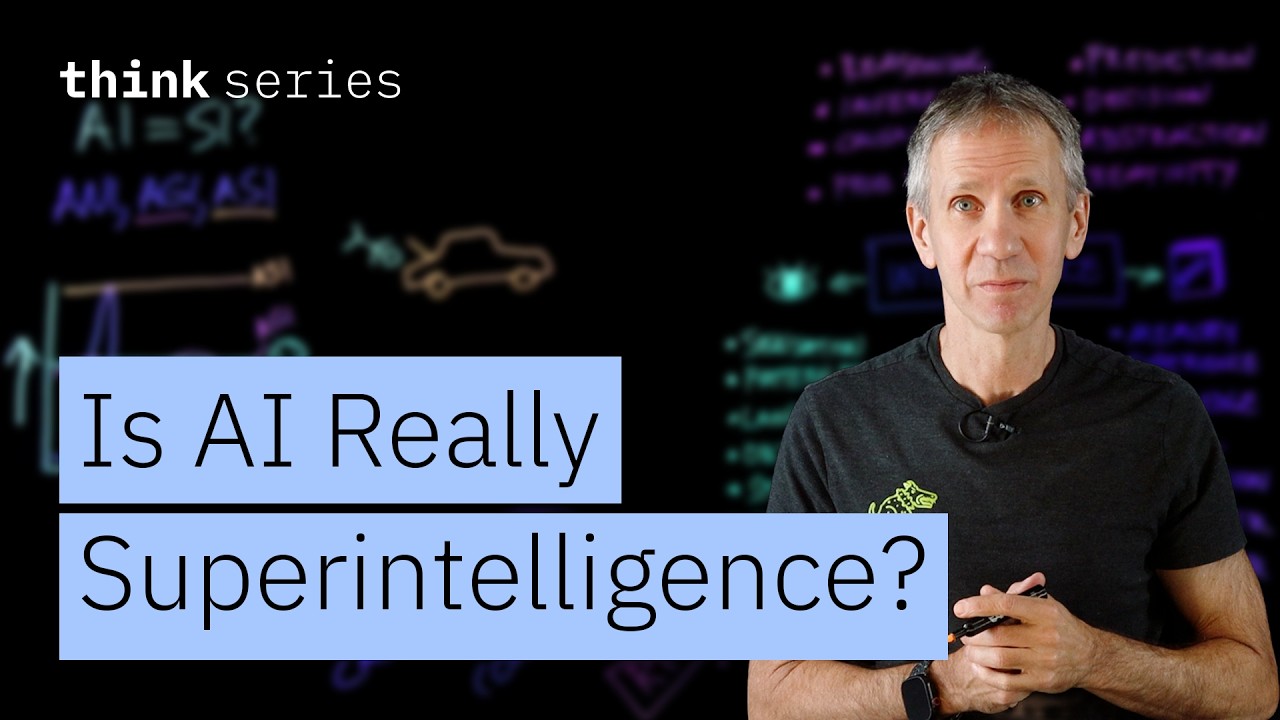
Is AI Really Superintelligence? ANI, AGI & ASI Explained
Summary
The video defines intelligence as a complex process involving perception, thinking, learning, and action. It distinguishes between three levels of AI: Artificial Narrow Intelligence (ANI), Artificial General Intelligence (AGI), and Artificial Superintelligence (ASI). The speaker emphasizes that current AI systems are ANI, meaning their capabilities are bounded by their design and training. Achieving superintelligence requires significant advancements in control, governance, and ethical alignment to mitigate risks, as capability without control creates risk.
Key takeaways
-
Definition of Intelligence
Intelligence is defined as the ability to perceive, think, learn, and act, going beyond merely memorizing facts or following programmed, step-by-step instructions.
-
ANI vs. AGI vs. ASI
12:07
ANI (Artificial Narrow Intelligence) performs specific tasks well (e.g., chess engine, recommendation systems). AGI (Artificial General Intelligence) matches human capabilities across many domains. ASI (Artificial Superintelligence) substantially exceeds human intellectual capabilities.
-
The Importance of Control
The relationship 'Capability minus Control equals Risk' highlights that powerful AI requires technical safeguards, security, governance, and human oversight to ensure alignment with human interests.
More digests on Artificial Intelligence
Technical details
-
Components of Intelligence
223s
Intelligence is broken down into four core areas: Perception (e.g., pattern recognition, language understanding, spatial awareness), Thinking (e.g., reasoning, causal reasoning, problem solving, abstraction), Learning (e.g., memory, knowledge acquisition, adaptation, metacognition), and Action (e.g., planning, goal pursuit, motor control).
-
ANI Limitations
727s
ANI systems are highly specialized; they can be 'a genius in some areas and an idiot in others,' meaning their capabilities are limited to what they were designed and trained to do.
-
Required AI Governance
To manage advanced AI, it is crucial to implement technical safeguards, security protocols, testing, and governance structures, ensuring a human remains 'in the loop' and in control.
Mentioned resources
Channel & topics
Watch on YouTube · Back to latest
This independent, AI-assisted summary is provided for commentary and informational purposes. It may contain errors or omit important context. Please watch the original video for the creator's complete presentation. Video, thumbnail, and related copyrights belong to their respective owners.