5 Types of AI Software Factories Clearly Explained
Summary
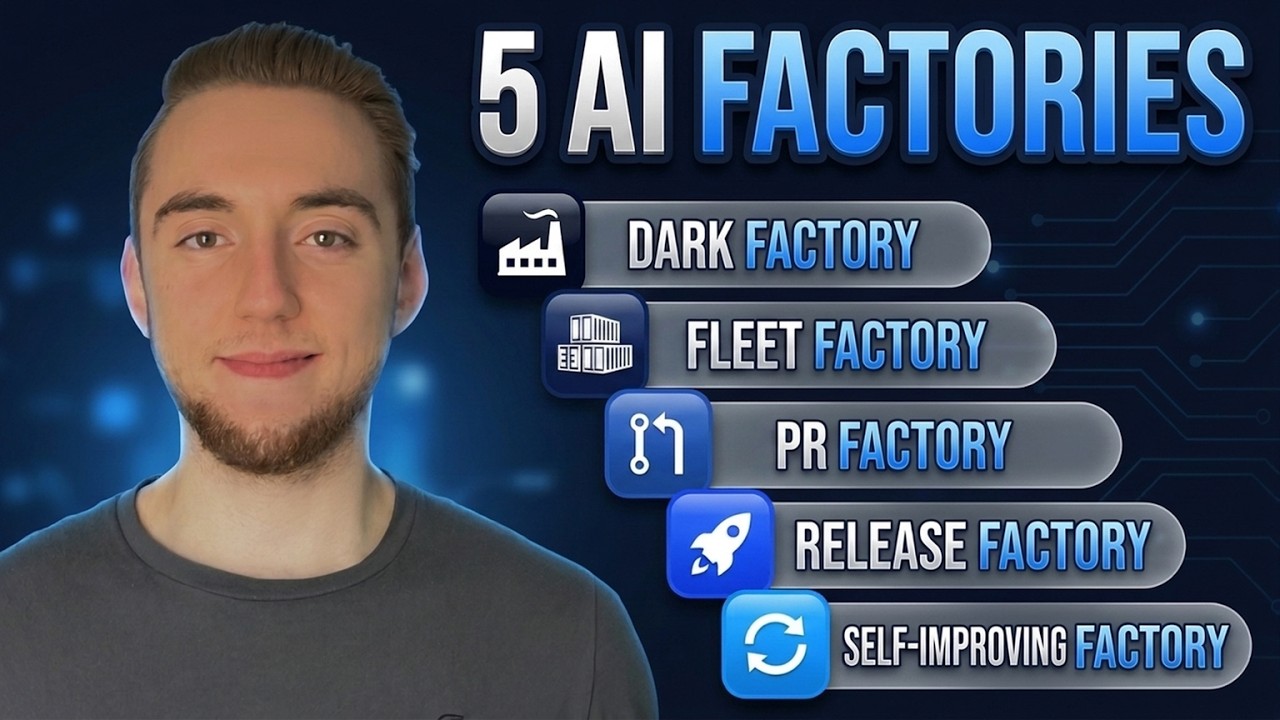
The video provides a detailed breakdown of five types of AI Software Factories, which represent increasing levels of autonomy for coding agents in the development lifecycle. These factories aim to scale software output by automating tasks like planning, building, and validating code in batches. The speaker recommends the 'Release Factory' as the optimal balance, combining high autonomy with necessary human oversight, while the 'Self-Improving Factory' represents the future state by integrating production monitoring signals back into the development loop.
Key takeaways
-
Dark Factory (The Pipe Dream)
4:50
A fully autonomous system that manages the entire application with no human review. While highly efficient, it is prone to failure because human intent cannot be perfectly communicated 100% of the time, leading to bad implementations shipped straight to production. Best used only for quick Proof of Concepts (PoCs).
-
Fleet Factory (Clear Outcomes)
7:37
Focuses on parts of the application with clear, measurable goals, such as migrations or refactors. It relies on robust automated testing to prove the work is correct, allowing for less human intervention than other models.
-
PR Factory (Maximum Reliability)
10:18
The most reliable form, as it requires reviewing every single Pull Request (PR). While highly safe, the human review process can become a bottleneck, limiting the overall scale of the factory.
-
Release Factory (Recommended Balance)
16:51
The optimal balance of autonomy and control. It processes a 'work order' (typically 10-20 tickets) in batches, handling dependency mapping and validation at the staging environment level, rather than reviewing every individual PR.
-
Self-Improving Factory (Future State)
Builds upon the Release Factory by integrating production signals (e.g., from Langfuse, Post Hog, Sentry). The system uses real-world usage data to automatically create new, actionable issues for the factory to address, making the system truly self-improving.
Technical details
-
AI Software Factory Mechanics
1011s
The process involves a heavily involved planning phase (creating a PRD), splitting the work into issues, running parallel build loops (each with a fresh coding agent session), and utilizing separate agent sessions for testing and code review. The goal is to scale output by automating the middle steps (building/validating) while keeping human involvement in planning and final validation.
-
LangSmith and Agent Debugging
390s
LangSmith allows for tracing agent runs, which is crucial because agent failures often do not throw explicit errors (e.g., looping or skipping tool calls). LangSmith's engine scans these traces to find failures, providing diagnosis, exact traces, and proposed fixes.
-
Factory Workflow Comparison
457s
The key difference between factories is the level of human review (Y-axis) versus the confidence in automated testing (X-axis). The Release Factory aims for the sweet spot: high confidence in testing without requiring review of every single PR.
Mentioned resources
Channel & topics
Watch on YouTube · Back to latest
This independent, AI-assisted summary is provided for commentary and informational purposes. It may contain errors or omit important context. Please watch the original video for the creator's complete presentation. Video, thumbnail, and related copyrights belong to their respective owners.