Topic

LLM Inference

All digests tagged LLM Inference

Suggested route

Topic journey

Move from earlier context through the available material to the newest signals. This route is a reading aid, not a difficulty ranking.

Start here

KV Cache-Aware Routing and P/D Disaggregation on Kubernetes — Yuchen Fama & Ashish Kamra, Red Hat Aug 27, 2026 · 21:48 Learn how KV Cache-Aware Routing and P/D Disaggregation optimize LLM inference for agentic workloads. Discover strategies to reduce P99 latency from 900ms to 100ms using advanced Kubernetes patterns.

Build context

Deep dive on LLM Inference at Scale — Harshul Jain, Audible & Tanmay Sah, Independent AI Researcher Sep 8, 2026 · 1:28:12 This deep dive covers LLM inference optimization at scale, detailing how memory and compute costs are managed through techniques like Paged Attention, Continuous Batching, and model quantization. Build A Reasoning Model From Scratch 4: Inference Scaling 1 (Temperature, Top-p, Self-Consistency) Sep 19, 2026 · 1:37:12 This deep dive explores inference-time scaling techniques for LLMs, covering Chain-of-Thought prompting, Temperature Scaling, Top-p filtering, and Self-Consistency. Learn how to boost model accuracy by managing compute trade-offs. Are LLM Performance Benchmarks Reliable? — Ashok Chandrasekar & Jason Kramberger, Google Sep 19, 2026 · 16:07 Discover why LLM performance benchmarks are often unreliable. Learn how to use Inference Perf to achieve high-fidelity, reproducible, and production-scale benchmarking for your inference stack.

Recent signals

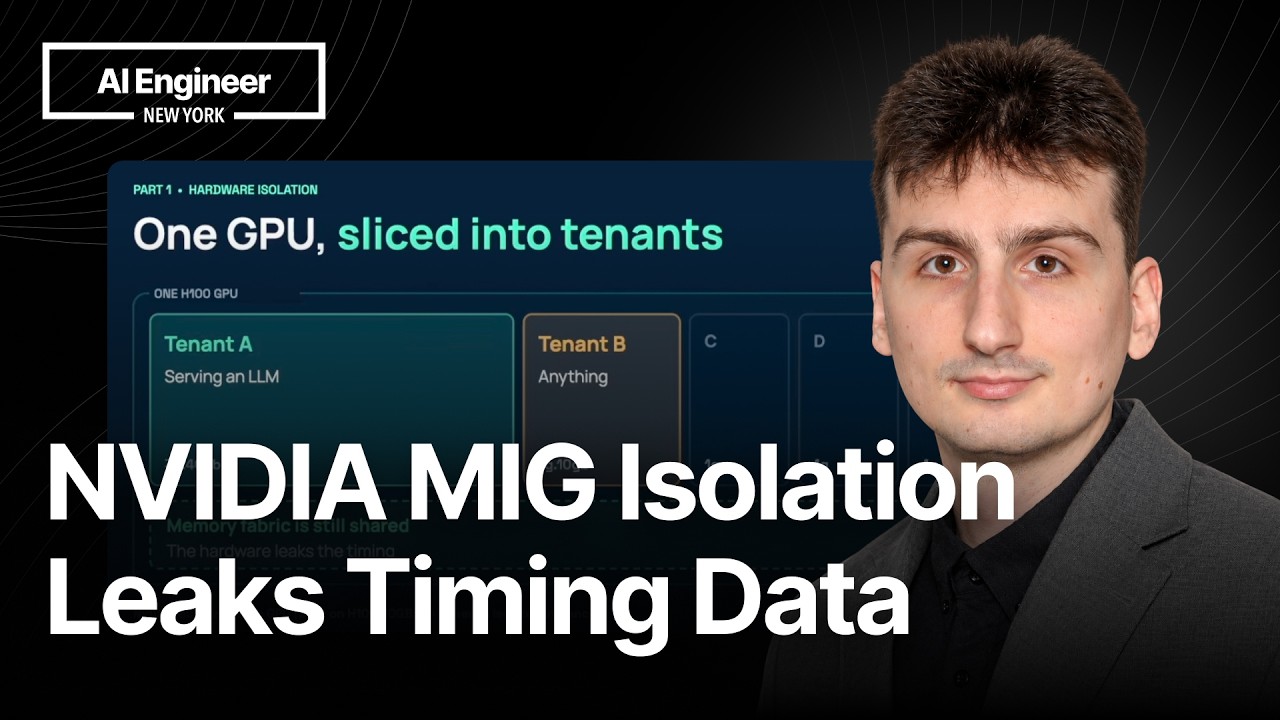
What Is LLM Inference? How AI Models Generate Responses Oct 22, 2026 · 7:46 LLM inference is the process of running a trained model against new input. It involves tokenization, continuous batching, and two phases: compute-bound prefill and memory bandwidth-bound decode. The AI Memory Wall: Why LLMs & AI Accelerators Hit a Bottleneck Oct 18, 2026 · 12:21 The Memory Wall explains why faster chips don't guarantee faster AI. Learn how Arithmetic Intensity and the Roofline Model help diagnose if your LLM workload is compute-bound or memory-bound. Your GPU Neighbor Can Hear Your Model — Branislav Brzak, Stealthium Oct 12, 2026 · 13:21 An H100 timing side channel allows an attacker to infer an LLM's model type, depth, and decoding speed by monitoring microsecond timing variations on shared GPU hardware, even without reading memory or exploiting bugs.

Browse view