
Give the Agent a Budget, Not a Token — Sachin Malhotra, Anthropic
Instead of giving an agent a token, give it a budget. A budget has four dimensions: how much, how fast, what can be undone, and who notices.
Read articleChannel
Digests from AI Engineer
Instead of giving an agent a token, give it a budget. A budget has four dimensions: how much, how fast, what can be undone, and who notices.
Read article
Building agents has become trivial due to cloud primitives, but missing institutional context remains the biggest failure point. A Context Engine solves this by synthesizing knowledge from docs, code, and tickets, preventing outages.
Read article
To make AI apps look professional, developers must focus on UX polish and avoid common 'slop' patterns (like purple gradients). Use visual references, break tasks into small prompts, and iterate with smaller open-source models.
Read article
Uber's Software Factory leverages agentic AI across six building blocks: Model Gateway, MCP Gateway, Skills Marketplace, Context Graph, and Minion agents. This infrastructure has increased PR generation by 70% and doubled code output per engineer.
Read article
To unlock agent autonomy, we need a new runtime layer enforcing safety. This system uses Containment, Scoped Capabilities, and Intent-Based Access to prevent agents from expanding their blast radius.
Read article
Fine-tuning LLMs can create a 'calcification tax,' leading to architectural lock-in. Migrating to an agentic framework using skills and context reduced fix deployment time from weeks to under an hour.
Read article
Learn how to automate a job using agents: Niels Rogge discusses building two systems—a deterministic workflow and an autonomous agent loop—to scale artifact discoverability at Hugging Face.
Read article
Compound Engineering suggests that efficiency comes from spending half your time building a feature and half teaching the system what it got wrong. This process compounds knowledge, making future development easier.
Read article
Autonomous AI agents require enterprise-grade governance, moving beyond simple prompt engineering. The solution involves implementing privilege separation and robust identity standards to manage delegated authority.
Read article
AI agents have made building a core leadership function. By automating context gathering and overnight coding runs, leaders can prototype features, optimize LLM calls, and train custom models using minimal hands-on time.
Read article
AI models are no longer the bottleneck in code review; context is. The future requires moving from line-by-line diff checking to reviewing an entire software development graph that tracks service contracts and dependencies.
Read article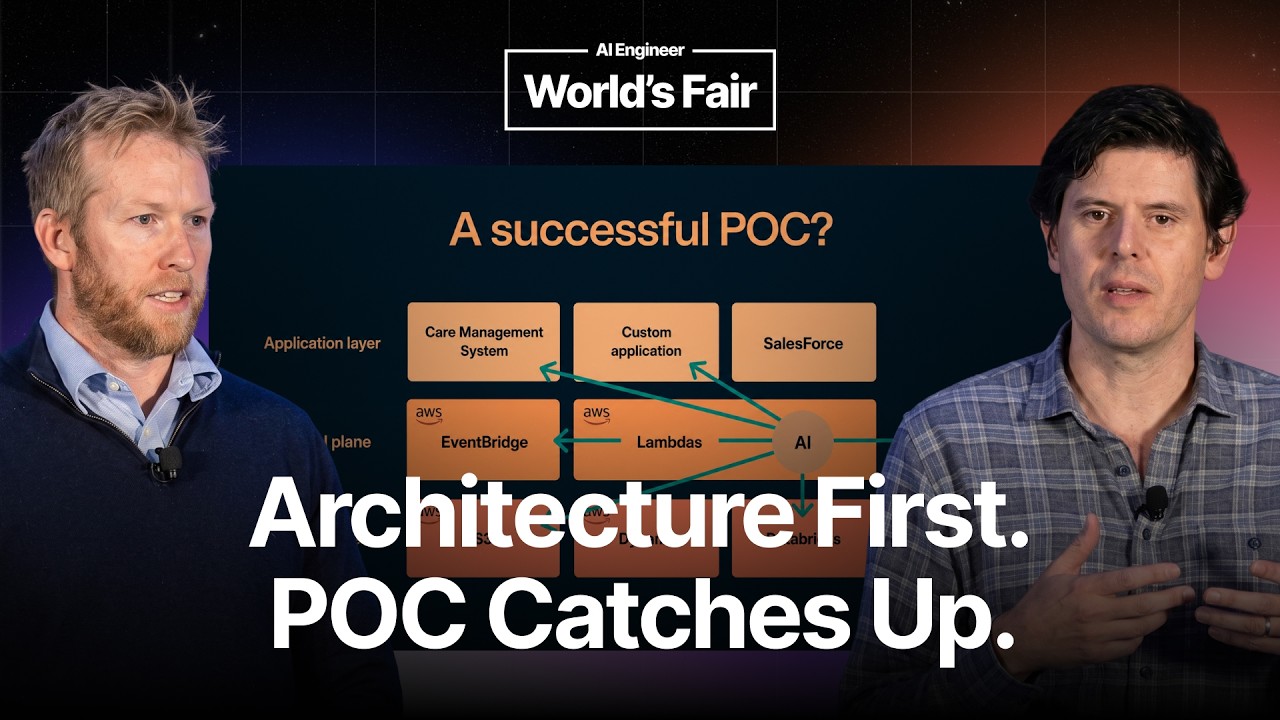
Building AI agents in regulated environments requires prioritizing immutable event logs, schema-driven object storage, and human agent equivalency over initial POC accuracy to ensure compliance.
Read article
When PHI is too sensitive to keep, how do you build datasets? Learn about reversing inference workflows and using LLMs to synthetically generate high-fidelity medical records.
Read article
Building takes minutes now, but arguing is what is expensive. The shift to AI-native requires moving from months of planning to rapid 2–4 week sprints and fundamentally changing code review processes.
Read article
Applied vertical AI's true moat is not the model or infrastructure, but proprietary data and domain expertise. The key to success is narrowing the problem scope and integrating human experts into a continuous learning loop.
Read article
X12 should be treated as a structural harness, not just a file format. This approach grounds AI agents in the contract between providers and payers, ensuring reliable claims processing despite contradictory data sources.
Read article
Shipping AI safely requires moving beyond A/B testing. The solution involves building an evaluation stack using simulation (Matrix) and automated prompt optimization (Jeppa) to prove safety before patient exposure.
Read article
Building member-facing healthcare AI requires guardrails that are architectural, not just prompt-based. Safety must be built into three foundations: PHI stripping at ingestion, deterministic code layers for high stakes, and continuous monitoring.
Read article
Abridge addresses the administrative burden in healthcare by building clinical intelligence tools that decompose complex tasks into smaller, specialized models to manage cost and latency at scale.
Read article
To train Krea 2, we built a system that handles crashes at scale and uses advanced metrics like tensor core utilization and InfiniBand monitoring to ensure stability.
Read article