How OpenAI Puts ChatGPT to Work | DevDay 2026
Discover how OpenAI's teams use ChatGPT as an agentic teammate to automate complex workflows, from monitoring social feeds to scaling competitive research. Learn about Spaces and Dots.
Read article
Discover how OpenAI's teams use ChatGPT as an agentic teammate to automate complex workflows, from monitoring social feeds to scaling competitive research. Learn about Spaces and Dots.
Read article
Higgsfield enables developers to build complex, interactive media using agentic systems that self-provision compute and choose optimal models like Astra, democratizing high-end content creation.
Read article
Stack Overflow details how they used Codex to build two products: a constrained enterprise knowledge layer (Stack Internal) and an agent-first platform (SOFA). Learn about 'archetypes' and designing for agent contribution.
Read article
NVIDIA introduces the Vera Rubin platform, an integrated AI factory designed for extreme co-design. Learn how advanced networking (Spectrum-X) and specialized CPUs enable reliable, scalable AI infrastructure for the next generation of Agentic AI.
Read article
The Software Factory proposes an autonomous system of agents that converts input signals (like bug reports) into production code. The focus shifts from coding to governing agents, emphasizing model-agnostic principles and measuring outcomes like signal-to-production time.
Read article
This tutorial details deploying a standalone VLM kiosk on NVIDIA Jetson using Codex. The process involves local asset serving, configuring automatic full-screen startup, and verifying local inference without cloud dependency.
Read article
Learn how Gemini and Google AI Studio transform code into physical textile art. This project demonstrates embedding meaning into knitting using binary algorithms.
Read article
Connecting agents is a distributed systems problem requiring solutions for ordered transport, persistence, and runtime binding. BAND introduces an interaction layer to solve the single-agent bottleneck.
Read article
The session details how CoreWeave uses the NVIDIA Vera Rubin NVL72 platform to scale AI workloads. Innovations like Racky and Valve, combined with RLCC automation, ensure reliable, high-density, liquid-cooled compute environments.
Read article
Physical AI is moving from the lab to industrial sites. Success requires a closed-loop data flywheel, combining multimodal data, advanced simulation, and edge computing to solve the sim-to-real gap.
Read article
Pinterest details its massive ML platform migration from MLflow to Weights & Biases. Learn about achieving system parity, zero downtime, and implementing governance guardrails at scale.
Read article
Building a Voice OS requires moving beyond accurate ASR to mastering latency, personalization, and style inference. The talk details using LLMs and RL to structure raw speech into polished, usable communication.
Read article
The Gemini Interactions API handles server-side state and long-running background jobs, replacing user/model turns with a structured timeline of steps. Agents run in a managed cloud sandbox, allowing them to execute code and share persistent environments.
Read article
The shift to open intelligence means owning the entire AI stack. Customization now involves RL, environments, and controlling data/safety, moving beyond simple API calls.
Read article
Discover Computational Knitting: a project that uses Gemini AI to translate algorithms and binary code into unique, physical textiles. Learn how digital data can be woven into fabric.
Read article
Scaling AI agents requires more than just tools. Success demands redesigning the entire workflow, remodeling roles, and building trust incrementally through automated code review and merging.
Read article
AI News & Strategy Daily | Nate B Jones
The speaker argues that AI leaderboards are dead. The true measure of AI success is 'customer obsession'—building products that solve specific, complex user pain points, not just topping a benchmark.
Read article
Learn how to build a self-improving company by turning agent failures into reusable skills. We discuss using MCP as the distribution layer and creating an organizational flywheel that captures hard-won knowledge.
Read article
Adam Cogan explores the shift from Copilot hype to agentic AI workflows. Learn how agents are reshaping the enterprise stack, improving security, and changing the developer's role from coder to prompt engineer.
Read article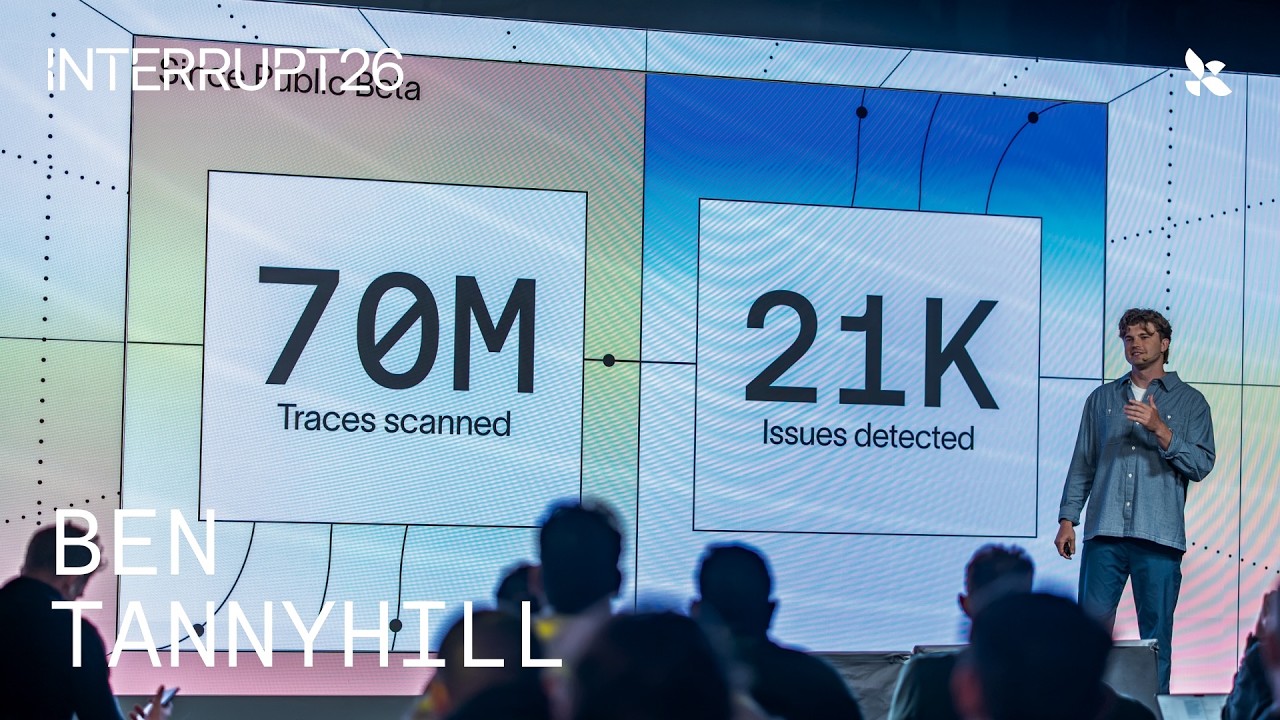
LangSmith Engine v2 automates agent development, offering validated fixes, red teaming, and cross-trace analysis to improve AI agents before production.
Read article