Your Sub-Agents Are a Distributed System. Treat Them Like One. - Girish Konda, Microsoft
Summary
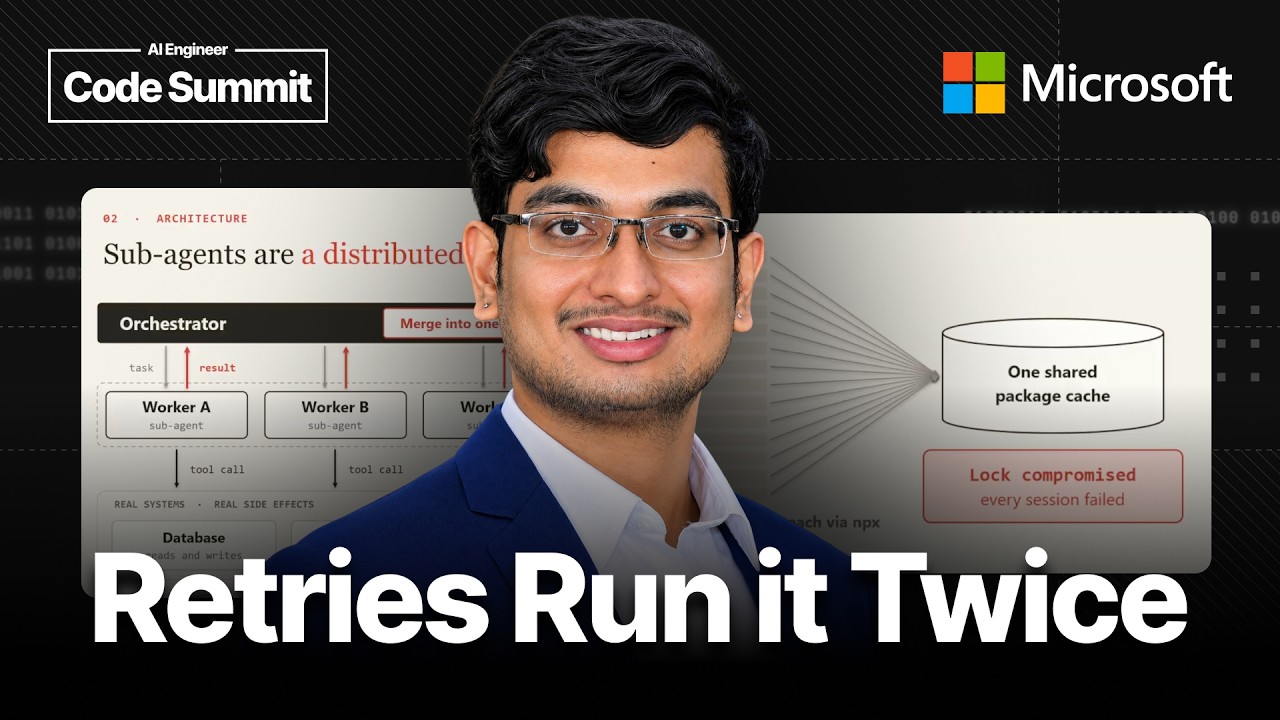
The talk argues that when an orchestrator delegates tasks to multiple sub-agents running concurrently, the system functions as a classic distributed system. Failures encountered (e.g., partial success reports, dirty reads, lost replies) are not unique to AI agents. Girish Konda proposes the 'SAFE handoff' consistency model to manage these failures, ensuring that every fact, decision, and side effect is traceable, bounded, and explicitly stated, thereby treating every agent handoff as a reliable network call.
Key takeaways
-
Treat every handoff as a network call
21:40
Sub-agents must be treated like components in a distributed system, acknowledging that calls can fail halfway, be slow, or return duplicate results. The orchestrator must read a status, not just text, to determine the true state.
-
Adopt the SAFE Consistency Model
17:10
The proposed SAFE model enforces strict rules: Source Feeds (S), At Most Once effects (A), Fanout Budgets (F), Explicit Outcomes (E), and Unknown timeouts (U). This model must be enforced in code, not just relied upon in text output.
-
Enforce Source Fact Provenance
12:10
Every fact must carry its source, version, and scope (provenance) to separate an observation (fact with source/read time) from an inference (unsupported claim).
More digests on Distributed Systems
Technical details
-
Distributed System Failures in Agents
150s
Classic failures include partial failure (returning success text when work failed halfway), dirty reads (reading shared context guesses), unbounded fanout (rate limits the orchestrator never sees), and retries (running side effects twice without idempotency).
-
Dirty Reads and Quorums
550s
A dirty read occurs when a sub-agent reads a value before the writer commits. While SQL isolation levels exist, the shared context in agents is inherently unsafe. The traditional fix of using read/write quorums (Read Quorum + Write Quorum > Total) does not apply because agents read the same guess multiple times, not independent copies.
-
SAFE Hand-off Model Components
730s
S (Source Feeds): Facts must be treated as records with provenance (source, version, scope, read time). A (At Most Once): Requires idempotency and identity for every write/side effect. F (Fanout Budgets): Implements flow control and bounded weights for downstream calls. E (Explicit Outcomes): Every handoff must end in a named state (e.g., 'stale', 'unknown'), not just text.
-
Consistency Model Comparison
1100s
The model rejects strong consistency guarantees (Linearizable, Sequential, Causal) because they cannot maintain availability during network splits (CAP theorem). The SAFE model prioritizes consistency over availability for writes, refusing rather than guessing.
Mentioned resources
- MCP Pacemaker
- FLP paper (1985)
- Chandra and Toueg (1996)
Channel & topics
Watch on YouTube · Back to latest
This independent, AI-assisted summary is provided for commentary and informational purposes. It may contain errors or omit important context. Please watch the original video for the creator's complete presentation. Video, thumbnail, and related copyrights belong to their respective owners.