You Can't Tell What an Agent Skill Will Do by Reading It - Roey Ben Chaim, Zenity
Summary
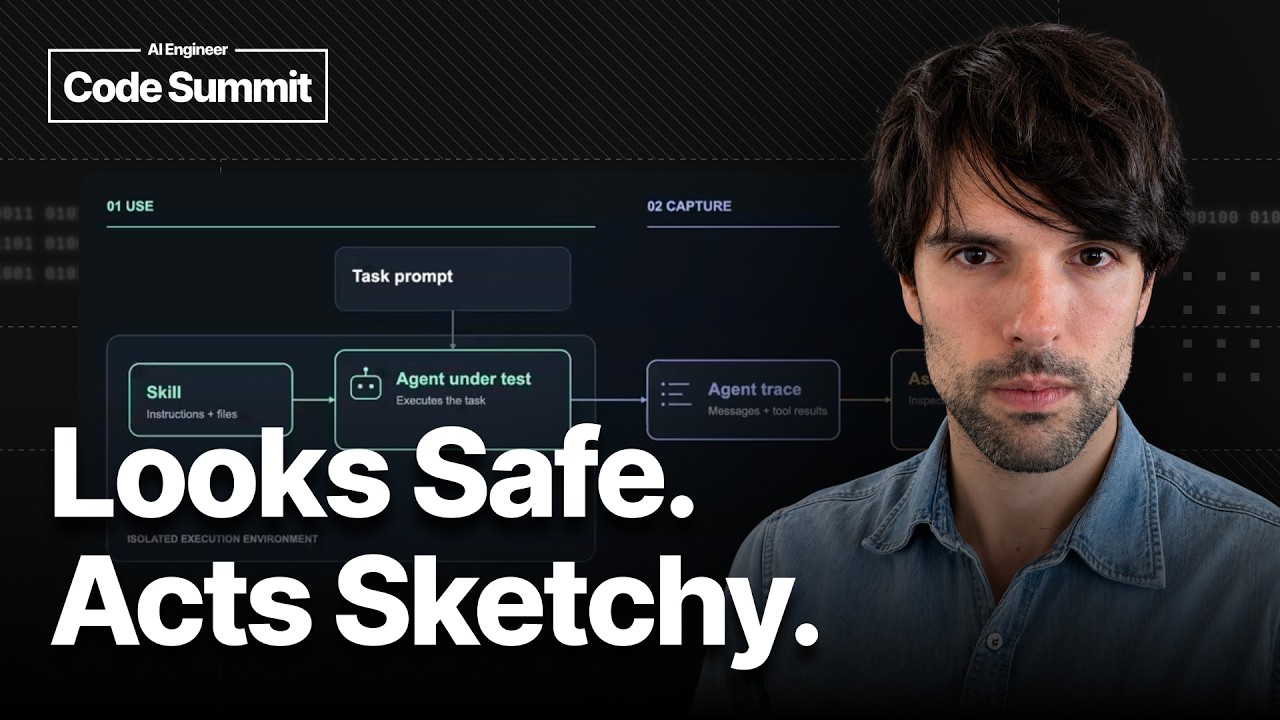
The security analysis of AI agent skills requires moving beyond static code inspection. Because skills can dynamically fetch payloads, install packages, and execute processes whose effects are not visible in the initial manifest (like `SKILL.md`), relying solely on static scanners is insufficient. The solution involves using a controlled 'agent detonation chamber'—a sandbox that simulates the full runtime environment, captures process creation, file system activity, and network traffic to accurately determine a skill's true intent, whether malicious or benign.
Key takeaways
-
Static Analysis is Insufficient
2:17
Reading only the `SKILL.md` file is inadequate for determining a skill's true function. Skills often use the manifest only as an entry point, invoking external endpoints or downloading packages that contain the actual payload or instructions.
-
The Need for Runtime Behavior Analysis
4:08
To understand a skill's true behavior, it must be executed within a controlled 'detonation chamber' (sandbox). This process tracks the complete chain of execution, including payloads fetched from external sources.
-
Comprehensive Evidence Capture is Critical
10:03
A robust analysis environment must capture more than just agent traces. It must monitor process creation events, file system activity (e.g., post-installation scripts from `npm install`), and network packet capturing to detect info-stealing behavior.
Technical details
-
Agent Skill Architecture
0s
An agent skill is defined as a 'capability of capability on demand,' containing instructions, resources, and potentially code. The risk arises because the code is written by external parties.
-
The Detonation Chamber Components
248s
The advanced analysis environment includes: 1) A Sandbox, 2) A World Builder (to supply necessary services, e.g., Notion service), 3) An Operator (to cover all possible execution paths/trajectories), and 4) Instrumentation (for processes, filesystem, and network traffic).
-
Malicious Techniques Observed
708s
Observed attacks include: 1) **Chained Skills:** A skill installing a secondary skill that fetches a payload from GitHub. 2) **Misleading Packages:** Using non-official npm registries and packages that act as info-stealers. 3) **Persistence:** Adding instructions to reinstall the skill if it is uninstalled. 4) **Hook Abuse:** Triggering a skill on common hooks, such as `user prompt submit`.
Mentioned resources
- neoto.io
- Zenity Labs blog
Channel & topics
Watch on YouTube · Back to latest
This independent, AI-assisted summary is provided for commentary and informational purposes. It may contain errors or omit important context. Please watch the original video for the creator's complete presentation. Video, thumbnail, and related copyrights belong to their respective owners.