Without Caching, Your AI Agent Costs 10x More - George Cameron, Artificial Analysis
Summary
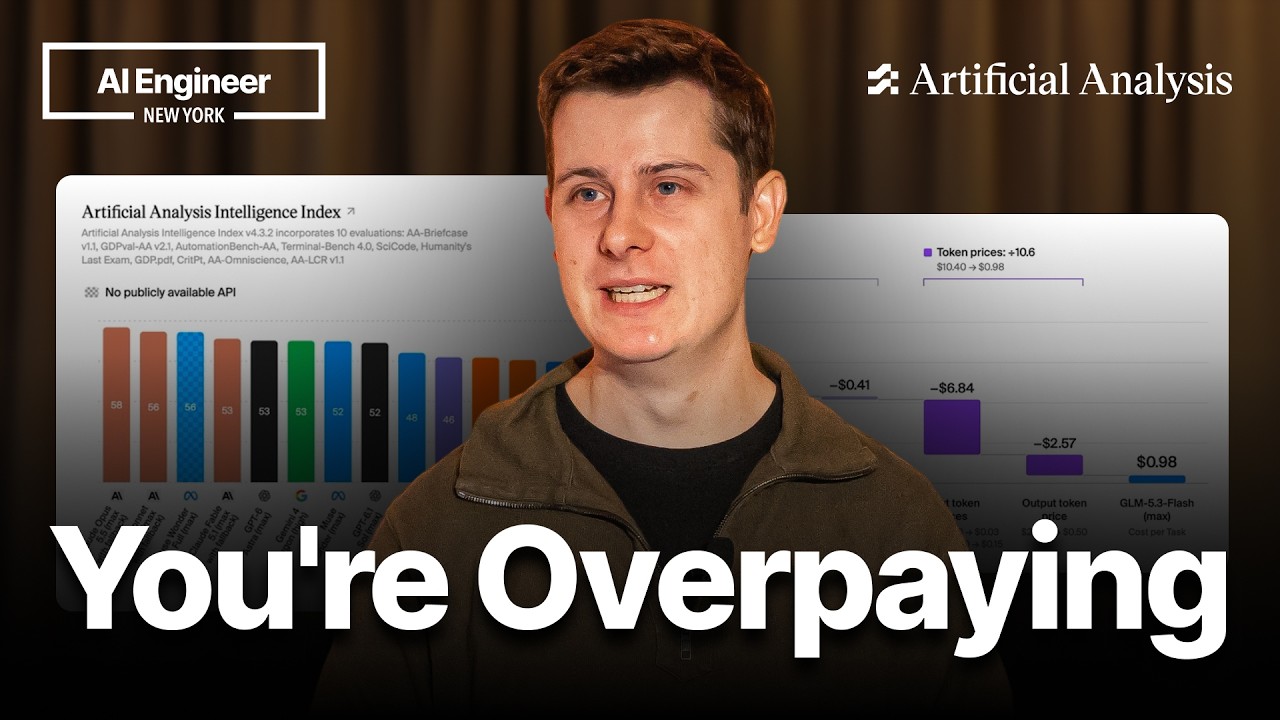
The cost of running AI agents is driven by more than just the model's intelligence; key cost drivers include input tokens, the cache hit rate, and the number of steps (turns) required for the task. George Cameron of Artificial Analysis emphasizes that neglecting caching can lead to costs increasing by orders of magnitude (e.g., from $21 to over $200 per task). Developers must make a strategic trade-off decision, classifying tasks as either 'unlimited intelligence' (where more intelligence always improves results) or 'limited intelligence' (where a cheaper model suffices).
Key takeaways
-
Cost Drivers in AI Agents
The cost of an agent task is determined by input tokens, the cache hit rate, and the number of steps (turns). The biggest cost driver for long-horizon agent tasks is the number of input tokens, followed by the proportion of those tokens that are cache hits, and finally, the number of turns per task. (12:59)
-
Impact of Caching
The cache hit rate is critical. If caching fails (zero cache hits), the cost can dramatically increase, illustrating a potential jump from $21 per task to over $200 per task. (13:38)
-
Model Selection Trade-offs
Developers should not automatically choose the most intelligent model. They must analyze the task's requirements against the cost-intelligence Pareto front. Tasks should be categorized as 'unlimited intelligence' (where more intelligence is always better) or 'limited intelligence' (where a cheaper model provides sufficient results). (15:30)
-
Cost Reduction Over Time
16:58
The cost to access a given level of intelligence (e.g., a 30 on the Intelligence Index) is rapidly decreasing. Historically, the cost could be over $1 per task, but it can fall to the $0.10 - $1.00 range within a year. (10:18)
More digests on AI Cost Optimization
Technical details
-
AI Benchmarking Scope
0s
Artificial Analysis benchmarks the full AI stack, including the agent layer, language models (for intelligence), image/video/speech models, and the hardware/inference layers, to understand inter-related tradeoffs. (0:00)
-
Intelligence Index
0s
The Intelligence Index is a synthesis metric of 10 different evaluations covering areas like knowledge work, scientific reasoning, and coding/terminal use, designed to help developers make decisions for next-generation use cases. (0:00)
-
Agent Cost Calculation
The cost per task must account for 'reasoning tokens' and 'input tokens,' not just output tokens. The cost calculation must also factor in the number of steps (turns) taken during agentic trajectories. (12:59)
-
Model Examples
The talk compared models like Opus (Anthropic) and GLM 5.3 Flash (open weights), demonstrating that cheaper models can be highly capable, provided the task is not limited by intelligence requirements. (15:30)
Mentioned resources
- Artificial Analysis
- AA Analyst Agent
Channel & topics
Watch on YouTube · Back to latest
This independent, AI-assisted summary is provided for commentary and informational purposes. It may contain errors or omit important context. Please watch the original video for the creator's complete presentation. Video, thumbnail, and related copyrights belong to their respective owners.