Why No One Agrees on What Their AI Tokens Cost - Pratyusha Duvvuri, Cisco
Summary
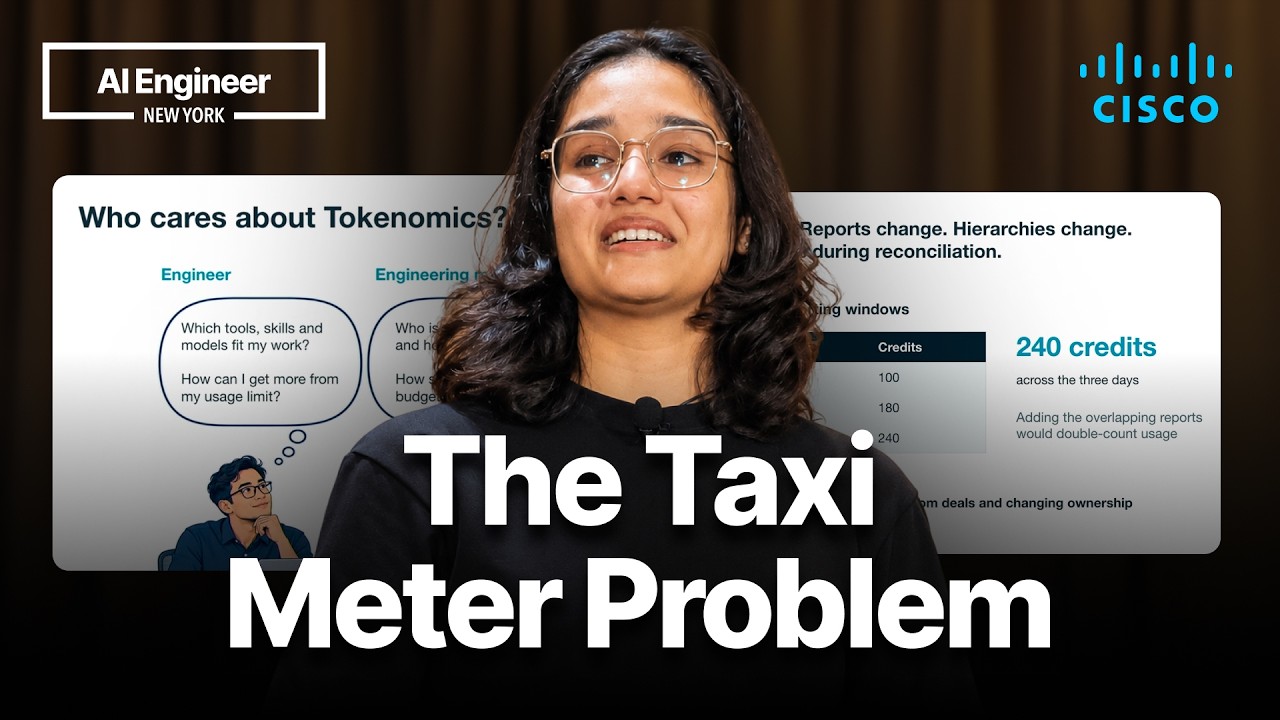
The presentation addresses the lack of consensus on 'tokenomics'—the cost and usage of AI tokens—by defining it as the observability and interpretability of token usage and cost. The speaker details three major trends in AI spending (status symbols, efficiency focus, and custom provider pricing) and introduces a comprehensive Tokenomics dashboard. This tool solves the challenge of aggregating usage data from multiple providers (e.g., OpenAI, Anthropic) and mapping costs across diverse organizational structures (Engineering, Management, and Finance) to provide actionable insights, forecasting, and ROI justification.
Key takeaways
-
Tokenomics Definition
0:08
Tokenomics is defined as the observability and interpretability of token usage and cost. Interpretability is linked to Return on Investment (ROI), helping users determine the proper usage and categorization of models based on their specific use case.
-
Three Trends in AI Spend
0:14
1) AI spend is becoming a status symbol. 2) There is a shift toward efficiency, optimizing tool calls and model usage (e.g., using a cheaper model for internal Evals vs. a premium model for customer-facing agents). 3) Providers use highly customized billing structures (e.g., 4 cents per credit vs. 3 cents per credit), necessitating specialized tracking.
-
Three Stakeholder Needs
0:11
Different roles require different data views: Engineers need to optimize model selection (Sonnet vs. Opus) and track budgets; Engineering Managers need to monitor adoption trends and overall usage; Finance teams require ROI justification, budget alerting, and mapping costs to financial hierarchies (OPEX/COGS).
More digests on AI Observability
Technical details
-
Data Aggregation and Reconciliation
12s
The dashboard aggregates data from multiple providers (OpenAI, Anthropic, etc.) and addresses the complex process of 'reconciliation,' where billing discrepancies can occur between providers and reported usage.
-
Data Inputs Required
12s
To function, the system requires three key data inputs: 1) A Workday/ADP company structure hierarchy; 2) API keys and Org IDs for all AI providers; and 3) A custom finance hierarchy (which differs significantly from standard HR structures).
-
Dashboard Functionality
15s
Key features include a Cost Dashboard, an Adoption Dashboard (tracking usage trends like Codex usage), and a critical Forecasting view that projects potential budget blow-through. The system supports hierarchical roll-up views by person, team, and job family, and a dedicated Finance View based on OPEX/COGS.
Mentioned resources
- Cisco
- Galileo
- AIE CODE summit
Channel & topics
Watch on YouTube · Back to latest
This independent, AI-assisted summary is provided for commentary and informational purposes. It may contain errors or omit important context. Please watch the original video for the creator's complete presentation. Video, thumbnail, and related copyrights belong to their respective owners.