Vibe Coding vs. Agentic Coding: Which Should You Use?
Summary
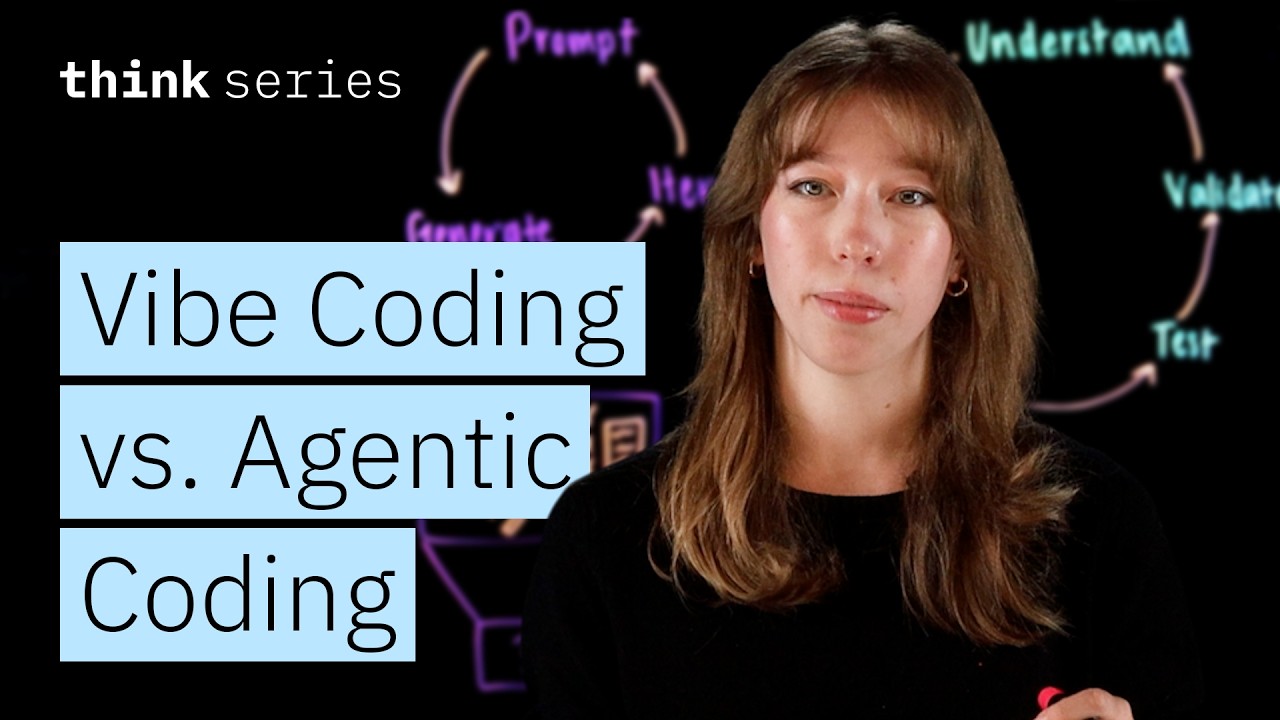
This analysis compares Vibe Coding (speed-focused, prompt-driven iteration) with Agentic Coding (structured, planning, and validation-heavy workflow). Vibe Coding is ideal for rapid prototyping, while Agentic Coding is necessary for complex production features, requiring mechanisms like subagents, governance, and guardrails to manage increased autonomy and risk.
Key takeaways
-
Vibe Coding Focuses on Speed
2:31
Vibe Coding relies on natural language prompting and iteration (Prompt -> Generate -> Iterate), making it excellent for rapid prototyping, demos, and visualizing ideas, even for non-coders. (01:51)
-
Agentic Coding Requires Structure
5:38
Agentic Coding is a more involved process (Understand -> Plan -> Execute -> Test -> Validate) where the AI acts as a tool, helping to understand existing codebases and manage complex changes. (02:41)
-
Security Scales with Autonomy
As coding agents gain more power (read/write code, execute commands), agentic security becomes critical, requiring testing, governance, observability, rollback, and guardrails. (06:04)
Technical details
-
Context and LLM Limitations
338s
LLMs operate on 'context' (files, tests, documentation, prompt info), but model attention is a finite budget. Too much context can hinder the agent's ability to map complex dependencies across a large codebase. (03:38)
-
Subagent Delegation
338s
Larger tasks in Agentic Coding can be broken down and delegated to specialized subagents, which are optimized for specific tasks and have scoped permissions (e.g., a test-running agent might not have GitHub access). (03:38)
-
Agentic Security Mechanisms
Key security features include testing (verification), governance (human sign-off on irreversible changes), observability (tracking agent actions), rollback (undoing mistakes), and guardrails (enforcing predefined rules). (06:04)
Mentioned resources
Channel & topics
Watch on YouTube · Back to latest
This independent, AI-assisted summary is provided for commentary and informational purposes. It may contain errors or omit important context. Please watch the original video for the creator's complete presentation. Video, thumbnail, and related copyrights belong to their respective owners.