The Revolution vs The Renaissance — Thariq Shihipar, OpenAI
Summary
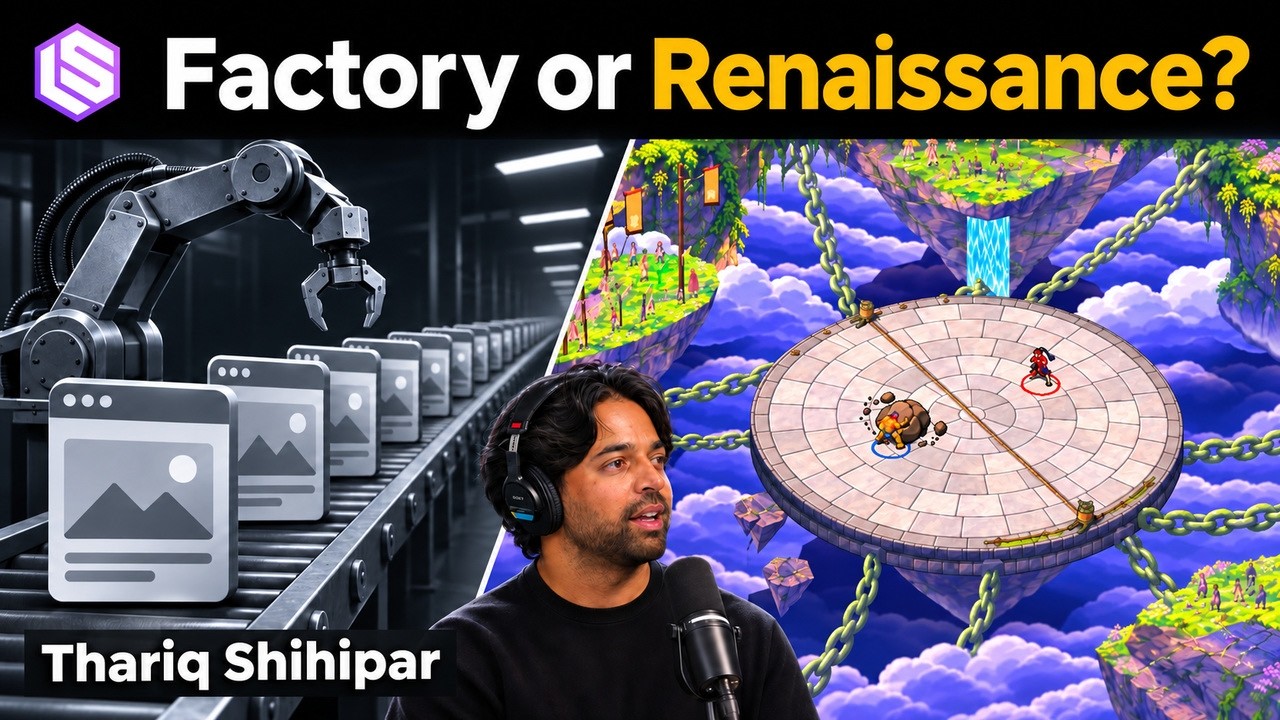
Thariq Shihipar discusses the dual nature of AI in software development—the 'Revolution' (efficiency, scale, low cost) and the 'Renaissance' (incremental quality, art, human refinement). He argues that the future of AI is not purely headless automation, but rather integrating human feedback loops, exemplified by his use of a custom `/human` scripting folder for game balancing. The discussion also covers advanced concepts like decision models, auto-research, and the challenges of compute allocation in large-scale AI projects.
Key takeaways
-
The Renaissance of Software
5:22
AI enables the 'Renaissance'—the ability to refine and raise the level of art in software, moving beyond mere industrial efficiency. This involves marginal quality improvements and human-in-the-loop tuning (03:22).
-
The Role of the Human Feedback Loop
10:47
Shihipar advocates for reintroducing human feedback loops to build ephemeral tools and test ideas, arguing that models often produce 'slop' when human testing is insufficient (06:47).
-
Decision Models as a Middle Ground
37:46
Decision models offer a middle ground between fully hard-coded AI and full inference loops. They allow for pre-written behavior that can still evaluate game state or user input (37:46).
-
Compute Allocation and System Design
The allocation of billions of dollars in compute is a critical human problem. Shihipar suggests that humans must brainstorm and approve experiments, as models are not yet clever enough to autonomously optimize compute usage (26:34).
More digests on Artificial Intelligence
Technical details
-
Agent Architecture and Refinement
647s
Shihipar uses a custom `/human` folder containing a scripting language for game design. This allows him to adjust primitives and understand the underlying logic, treating the code as a 'spec' rather than just an artifact (06:47).
-
Model Capabilities and Limitations
192s
Models are increasingly general, capable of working in various formats (e.g., drawing in Figma), challenging the previous belief that they were limited to specific formats like CLI or React (03:22).
-
Advanced AI Concepts
2266s
Discussions covered concepts like 'weight space programming,' 'memory models,' 'DPOP,' and 'RLCD,' emphasizing the difficulty in defining the objective function for these advanced systems (2266).
-
Deployment and Execution
Shihipar plans to run his game engine in `WebAssembly` (Wasm), with the scripting language acting as a lighter layer on top, demonstrating a hybrid execution model (15:07).
Mentioned resources
Channel & topics
Watch on YouTube · Back to latest
This independent, AI-assisted summary is provided for commentary and informational purposes. It may contain errors or omit important context. Please watch the original video for the creator's complete presentation. Video, thumbnail, and related copyrights belong to their respective owners.