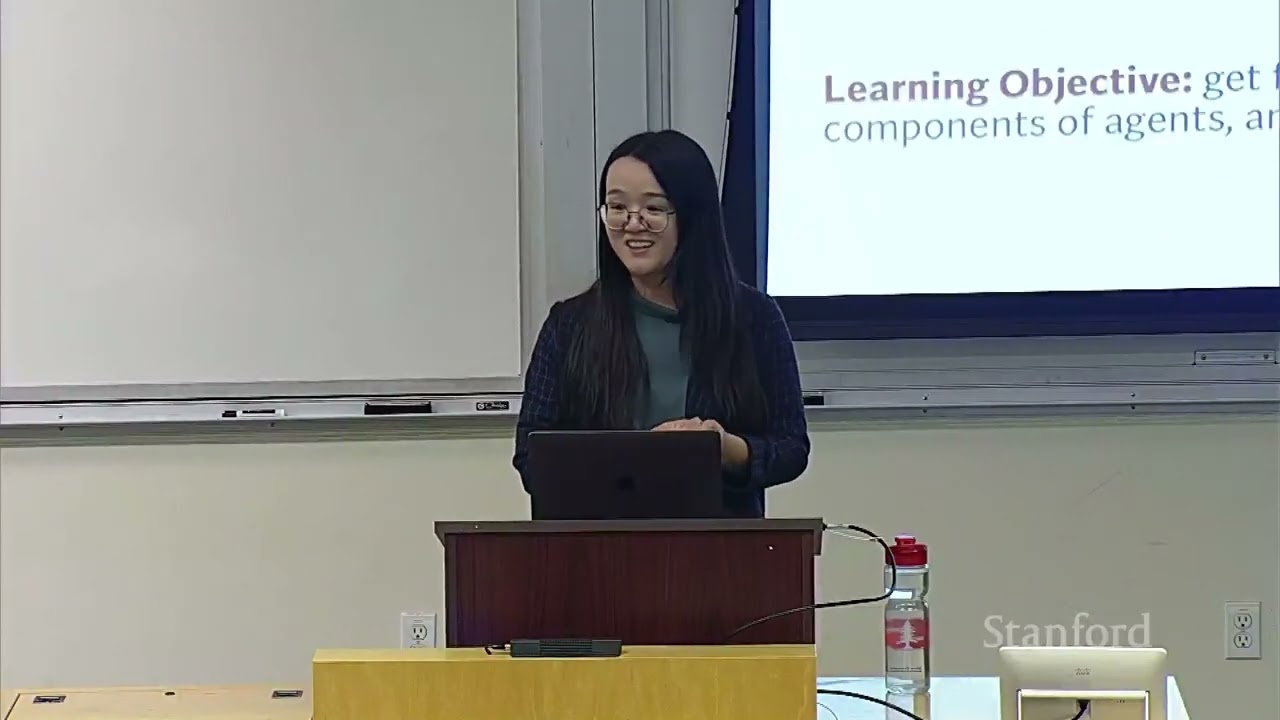
Stanford CS329Z Introduction — What Are Agentic Systems?
Summary
This lecture provides a comprehensive introduction to agentic AI systems, defining them as complex systems built upon Large Language Models (LLMs) that can perceive, reason, plan, and take actions in an environment. The architecture of an agent is detailed, comprising an LLM core, planning/reasoning modules, memory systems (episodic, semantic, procedural), and external tools. The discussion contrasts traditional fixed-step workflows with flexible, self-directing agents, emphasizing that while LLMs show rapid capability improvements, key challenges remain in reliability, safety, and robust evaluation.
Key takeaways
-
Agent Architecture Components
23:20
An agent is conceptually composed of an LLM core, planning/reasoning capabilities (e.g., Chain of Thought), memory (episodic, semantic, procedural), tool use, and an environment for action/observation. The system must manage these components in a continuous loop.
-
Workflow vs. Agentic Systems
31:00
A 'workflow' follows a fixed, predefined sequence of steps (e.g., a script), whereas an 'agent' uses the LLM to autonomously decide the next steps, making it more flexible and responsible.
-
The Agent Loop (ReAct)
25:39
The ReAct framework formalizes the agent loop: the model must cycle through thinking (reasoning), taking an action, observing the result, and then using that observation to inform the next thought, enabling self-correction.
-
Key Challenges in Agent Development
33:30
Despite impressive capabilities, agents face critical challenges, including reliability (gap between capability and reliability), safety (e.g., unauthorized actions), and privacy (handling sensitive personal information).
Technical details
-
Agent Memory Types
1352s
Memory systems are crucial for long-horizon tasks. Types include: Episodic (storing all raw logs/events), Semantic (synthesizing key events into summaries), and Procedural (storing abstract skills or procedures, like in a skill library).
-
Tool Use Protocols
1630s
Tool use allows agents to interact with external APIs. Early methods included Toolformer, while Gorilla demonstrated training LLMs on a vast set of APIs (over 1,600) to enable complex, factual generation by delegating tasks to external tools.
-
Model Context Protocol (MCP)
1821s
MCP is presented as a standard protocol designed to facilitate scalable connections between diverse AI applications (e.g., IDEs, code editors) and various data sources/tools (e.g., databases, Google Drive).
-
Advanced Reasoning Techniques
1579s
Techniques like Chain of Thought (CoT) and Reflexion improve reasoning. CoT prompts the model to reason step-by-step, while Reflexion allows the agent to self-reflect on its own trajectory using natural language feedback, significantly reducing errors and hallucination.
Mentioned resources
Channel & topics
Watch on YouTube · Back to latest
This independent, AI-assisted summary is provided for commentary and informational purposes. It may contain errors or omit important context. Please watch the original video for the creator's complete presentation. Video, thumbnail, and related copyrights belong to their respective owners.