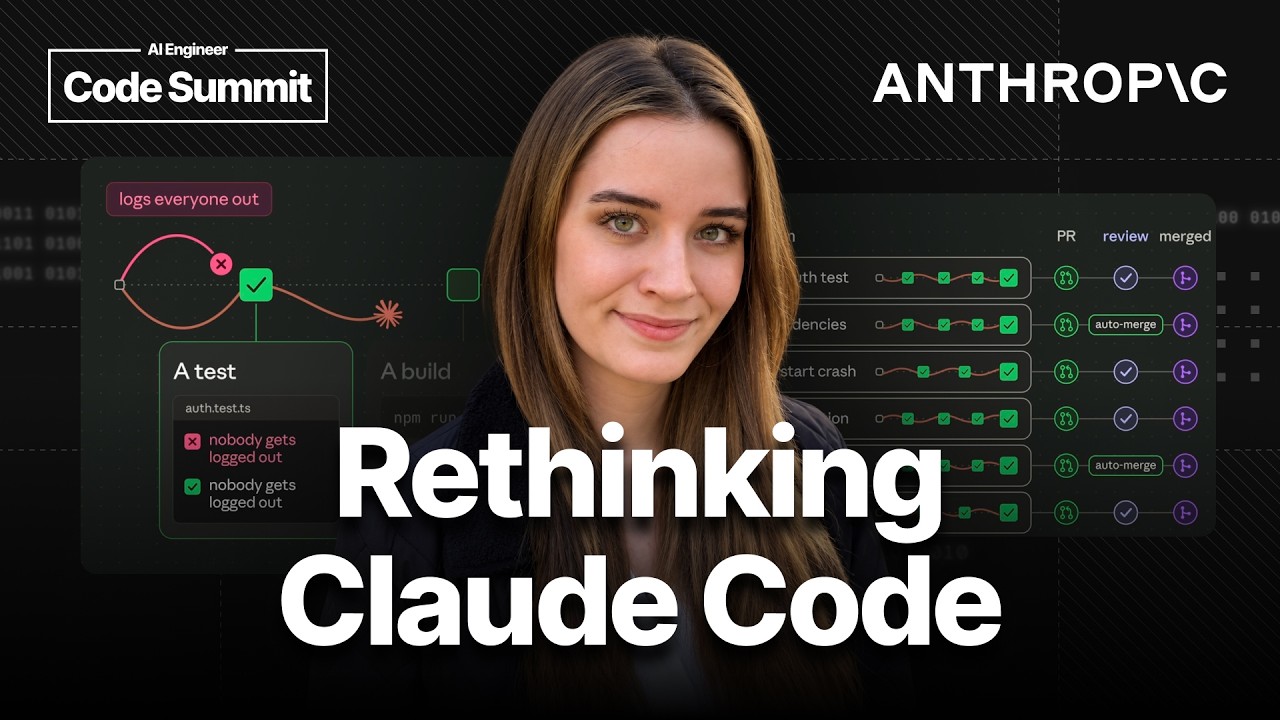
Rethinking Claude Code Best Practices — Lydia Hallie, Anthropic
Summary
As large language models (LLMs) like Opus 5.5 and Fable 5.2 improve, the best practices for using Claude Code are shifting away from manual human intervention (being 'in the loop'). The new paradigm involves leveraging model intelligence, automated permission systems (Auto Mode), and robust environment controls (sandboxing, CI/CD) to manage dozens of long-running sessions autonomously. Developers must now focus on configuring the environment and verification points rather than approving every command.
Key takeaways
-
Model and Permission Upgrades
0:45
The shift from older models (e.g., Opus 4.5) to modern versions (Opus 5.5, Fable 5.2) means models are better at understanding intent and codebases. Key changes include making 'Auto Mode' the default permission, reducing the need for manual command approval, and eliminating the need for overly restrictive instructions in the `cloudmd` file. (0:45, 1:20)
-
Shifting from Manual Control to System Controls
1:50
Previously, best practices focused on steering sessions and approving commands. Now, the responsibility shifts to the model, the harness, or the environment. The goal is to run multiple sessions concurrently and ensure safety and quality without constant human supervision. (1:10, 1:25)
-
Enhancing Safety with Deny Rules and Sandboxing
5:15
While Auto Mode is effective, absolute guarantees require system-level controls. 'Deny rules' are the best way to ensure Claude never performs a specific action. For preventing side effects from compromised scripts (e.g., reading sensitive files), running commands in a 'sandbox' environment is crucial, as it limits the OS-level reach of the process, not just the tool call. (3:15, 4:00)
-
Verification and CI/CD Integration
9:00
Since sessions run for hours in the background, verification points must be set up along the way (e.g., running tests or builds). The most reliable methods include setting up dedicated 'hooks' (scripts run at specific points) and relying heavily on Continuous Integration (CI) checks, which run the same checks on all resulting Pull Requests (PRs). (5:40, 6:30)
-
Orchestration and Context Management
12:20
Instead of managing many individual sessions, the recommended approach is to use a single 'orchestrator' session (like in Claude Code Projects). This orchestrator splits the main task into sub-tasks, automatically starting and verifying new threads, allowing developers to manage context without manual intervention. (7:40, 8:20)
More digests on LLM Best Practices
Technical details
-
Model Updates
35s
The speaker recommends upgrading from Opus 4.5 to Opus 5.5 and utilizing Fable 5.2. Opus 5.5 is noted for its improved ability to understand developer intent and codebase context. (0:35, 1:20)
-
Permission Modes
145s
The default permission mode should be set to 'Auto Mode.' This mode runs a classifier on non-reading/editing commands, automatically allowing safe actions (like running tests) while blocking unknown or potentially unsafe commands. (1:45, 2:10)
-
CloudMD Optimization
230s
The `cloudmd` file should be streamlined to only include information that Claude cannot deduce from the code itself (e.g., legacy source references). The `doctor prompt audit` command can help optimize the environment for a specific model. (2:30, 2:50)
-
Security Controls
330s
To guarantee safety, 'deny rules' are necessary, as they are checked by Cloud Code before the Auto Mode classifier. For deep security, running processes in a 'sandbox' environment is recommended to limit the OS-level reach of scripts and child processes. (3:30, 4:10)
-
Process Control
590s
When implementing custom verification, hooks (scripts run at specific points) are preferred over pure prompting, as they provide guaranteed control. When writing failure scripts, ensure they exit with a '2' exit code, as this signals Cloud Code to attempt a fix. (5:50, 6:10)
Mentioned resources
- Claude Code Projects
- Anthropic Documentation
Channel & topics
Watch on YouTube · Back to latest
This independent, AI-assisted summary is provided for commentary and informational purposes. It may contain errors or omit important context. Please watch the original video for the creator's complete presentation. Video, thumbnail, and related copyrights belong to their respective owners.