Paul Stack: I'll Never Write Infrastructure as Code Again
Summary
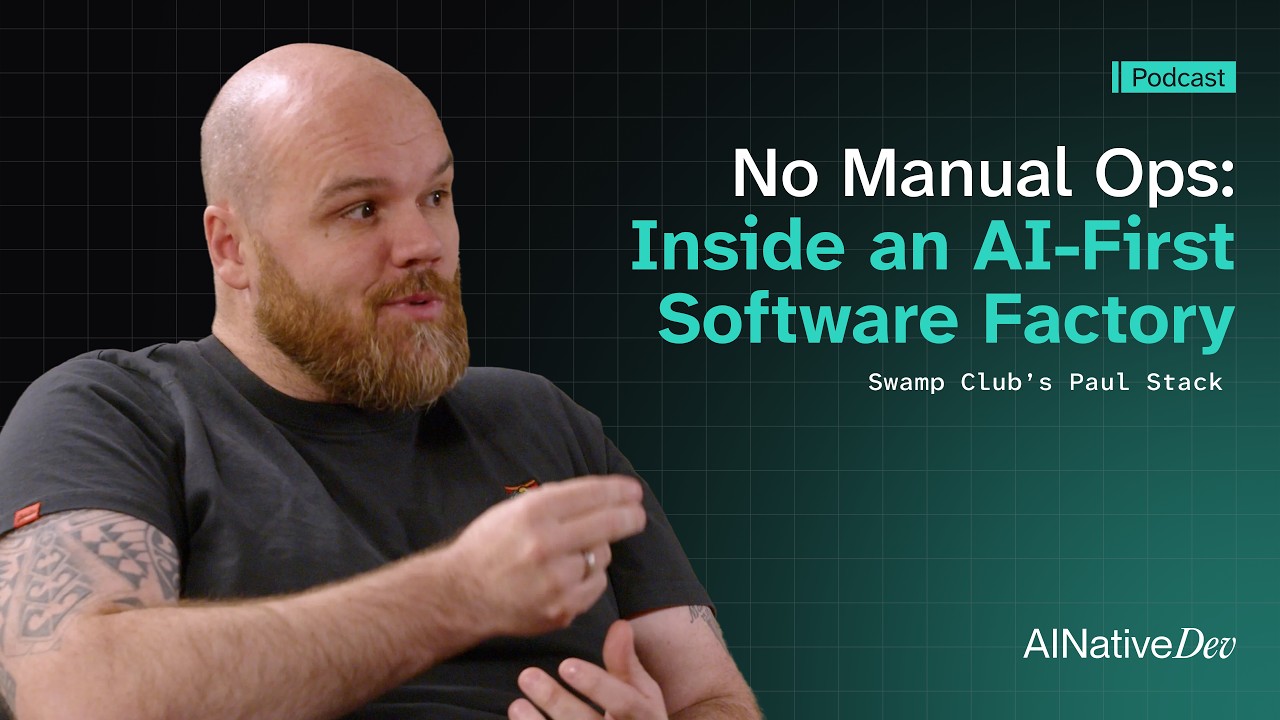
The industry is shifting away from relying solely on Infrastructure as Code (IaC) for managing production systems, favoring agent-driven 'software factories.' Paul Stack argues that while IaC tools like Terraform and Pulumi are useful for generating code, the real challenge lies in managing the system's state and automating complex, repetitive operational tasks (toil). Agents, when placed within a well-defined 'agent harness,' can perform full lifecycle operations—from issue to production, including data migration and alert triage—with high determinism, allowing human operators to focus on high-level judgment and decision-making.
Key takeaways
-
Agentic Operations vs. Traditional IaC
20:00
Agents are proving capable of complex, multi-layer migrations (e.g., Railway to GCP) that are difficult to manage purely through IaC due to multiple layers of abstraction (the '200% problem'). Agents are better at understanding the desired outcome (A to B) rather than strictly following declarative code.
-
The Role of the Agent Harness
28:20
The key to successful automation is the 'agent harness'—a system that provides determinism, contains access, and structures the workflow. This harness allows agents to execute defined 'behaviors' or 'skills' rather than relying on raw, unstructured access.
-
Automating Toil and Alert Triage
36:40
Agents excel at automating repetitive, manual operational tasks (toil), such as running complex runbooks or triaging alerts. By creating deterministic systems (e.g., for alert deduplication and correlation), agents can significantly reduce noise and provide structured context (a 'dossier') to human operators, who retain the final decision-making authority.
-
Human Judgment Remains Critical
55:00
Despite the advancements, human judgment, system thinking, and domain expertise are irreplaceable. The goal is not to replace engineers, but to use agents as a 'force multiplier' by automating the tedious steps, allowing humans to focus on complex decision-making (e.g., deciding if a rollback is necessary).
More digests on Agentic Workflow
Technical details
-
Infrastructure State Management
800s
A major pain point in IaC is the underlying 'state' layer. Agents struggle when they must interact with existing, complex systems because the state is difficult to model and move. The solution involves creating a 'digital twin' or a structured representation of the production state to inform the agent.
-
Agentic Workflow Design
1750s
Effective automation requires defining reusable 'behaviors' or 'skills' (like plugins/hooks) that have schemas and structured workflows. The system must be designed to pass context through a defined pipeline (e.g., Alert -> Verification -> Triage -> Action).
-
Cost-Effective LLM Usage
2800s
The speaker noted a significant cost reduction (91%) by using smaller, specialized models (like Jev) for initial classification and simple decision trees, reserving larger, more expensive frontier models (like Opus) for complex analysis.
-
Security and Access Control
2400s
When granting agents access, it is crucial to adhere to the principle of least privilege. Agents should only receive read-only access and minimal credentials, avoiding the sharing of broad API keys or environment variables.
Mentioned resources
- Swamp
- Terraform
- Pulumi
- Jev
- Anthropic (Claude)
Channel & topics
Watch on YouTube · Back to latest
This independent, AI-assisted summary is provided for commentary and informational purposes. It may contain errors or omit important context. Please watch the original video for the creator's complete presentation. Video, thumbnail, and related copyrights belong to their respective owners.