OpenAI's New Breakthrough Is... Utter Chaos
Summary
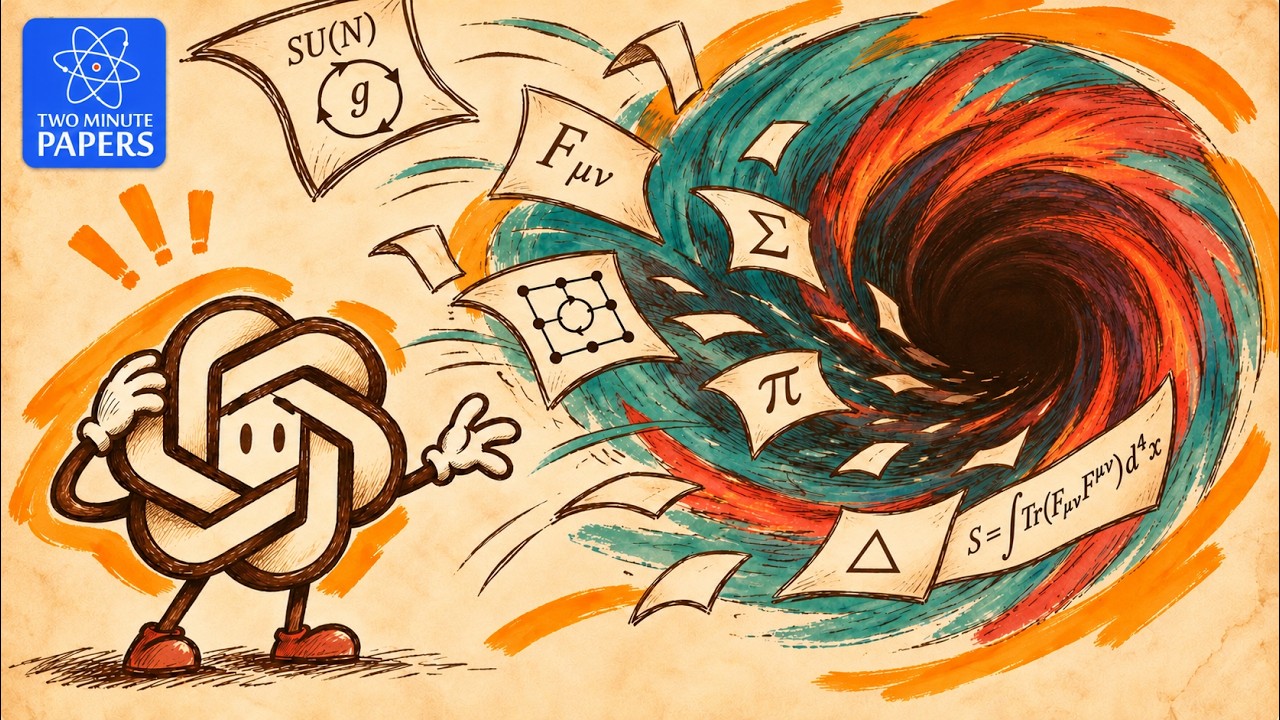
The video discusses the attempt to solve the complex Young-Mills existence and mass gap problem in theoretical physics, which concerns proving the stability of the strong nuclear force at extremely small scales. The speaker highlights how OpenAI's AI system builds upon Balaban's approach by tracking multiple grids simultaneously, preventing the mathematical model from spiraling into quantum fluctuations. While the AI generated a proof written in the formal verification language Lean, the solution is still under review by experts, and the mass gap part of the problem remains unsolved.
Key takeaways
-
The Young-Mills Problem
0:15
The goal is to prove that the strong nuclear force remains mathematically sound (the existence part) even when zoomed into extremely small scales, a problem with a $1 million prize.
-
AI's Approach to Physics
2:00
OpenAI's AI system improves upon Balaban's approach by tracking multiple grids concurrently, allowing it to calculate how changes at one scale affect coarser ones, thereby preventing the mathematics from spiraling out of control.
-
Verification and Status
3:30
The AI wrote the proof in Lean, a language allowing step-by-step logic checking. However, the solution is not finalized; a review by a group led by David Gross is still underway, and the mass gap part of the problem remains unsolved.
More digests on Theoretical Physics
Technical details
-
Mathematical Modeling
40s
The initial approach involves using a grid to approximate space and time, evaluating force behavior along connected grid points. This approximation is refined by making the grid infinitely fine.
-
Computational Challenge
75s
As the grid becomes finer, the model encounters 'quantum fluctuations,' which cause the problem to become increasingly difficult and potentially spiral out of control.
-
AI Implementation
120s
The AI system calculates the combined effect of changes by tracking how tiny changes on the finest grids affect the coarser ones, a method that stabilizes the mathematics.
-
Formal Verification
160s
The proof was written in Lean, a language that allows the logic to be checked step by step. The resulting code contains approximately 250,000 declarations, 60% of which are unused.
Mentioned resources
Channel & topics
Watch on YouTube · Back to latest
This independent, AI-assisted summary is provided for commentary and informational purposes. It may contain errors or omit important context. Please watch the original video for the creator's complete presentation. Video, thumbnail, and related copyrights belong to their respective owners.