My AI Agent Bought Me A Car
Summary
The discussion details the evolution of the Hermes Agent, moving from an internal productivity tool to a powerful, open-source agent capable of complex 'life admin' tasks, such as searching government auction sites or managing utility bills. The core focus shifts to advanced model improvement paradigms, particularly Recursive Self-Improvement (RSI). Key technical breakthroughs include the 'Trace to Environment' methodology, which synthesizes RL environments from agent failure traces, enabling continuous, automated self-training. Furthermore, the discussion explores advanced inference techniques like 'Activation Steering' and the optimization of reasoning effort to improve small model performance.
Key takeaways
-
Agent Capabilities and Use Cases
5:38
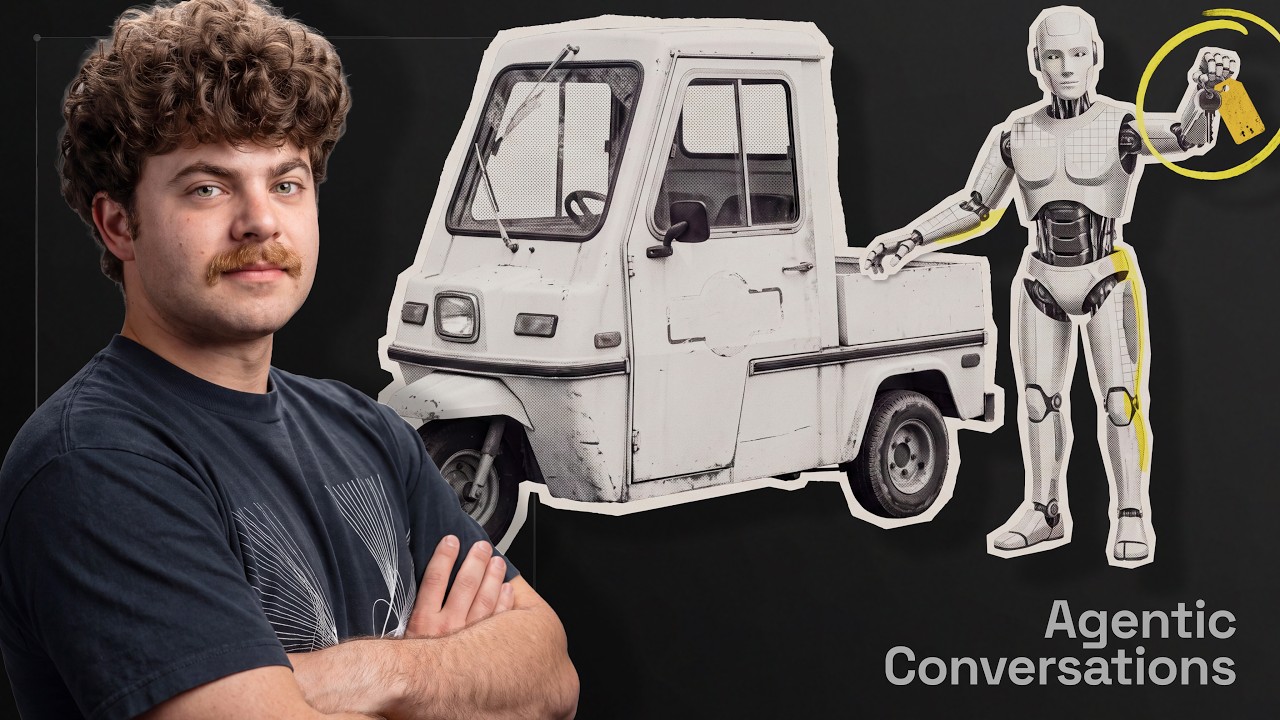
Hermes was initially developed as an internal productivity tool but has expanded to handle complex, multi-step 'life admin' tasks, including matching clothes to ancient pottery photos and automating searches on government auction sites for items like three-wheel parking ticket cars (3:38).
-
The Continual Learning Loop (RSI)
12:20
The most advanced paradigm involves collecting agent traces, performing 'failure analysis' to pinpoint mistakes, clustering these failures, and then synthesizing synthetic RL environments. The agent can then train on these environments, creating a continuous, automated self-improvement loop (7:40).
-
Hot-Swapping Weights for Self-Improvement
14:18
An early version of the agent demonstrated the ability to design an RL environment, kick it off on cloud compute, download the resulting weights, and 'hot-swap' them into the locally running model, enabling self-teaching (8:58).
-
Activation Steering for Inference Improvement
17:10
A promising, underexplored area is 'activation steering,' which involves multiplying external vectors into the last layer of the transformer during inference. This allows for dynamic behavioral guidance (e.g., making a model more pragmatic for math problems) without full retraining (10:30).
Technical details
-
Trace to Environment
740s
A methodology (credited to Xiaomi’s MiMo-V2.6-Pro) where agent traces (records of actions/failures) are used to synthesize realistic, synthetic RL environments. This allows the agent to train on its own mistakes in a controlled, automated manner (7:40).
-
Failure Analysis and Environment Synthesis
740s
The process involves identifying the precise points where an agent fails, clustering these failures by type, and then building a synthetic environment that accurately recreates the state of the system (e.g., file paths, directory structures) at the time of failure (7:40).
-
Activation Steering
1030s
A technique for improving model behavior at inference time. Instead of retraining, external vectors are multiplied into the model's final layer to guide the model's output toward a desired behavior (e.g., increasing pragmatism or creativity) (10:30).
-
Reasoning Effort and Token Efficiency
1050s
The discussion highlights the trade-off between reasoning length and efficiency. While longer reasoning traces are often assumed to be better, the speaker posits that models may 'overreason,' suggesting that less reasoning might suffice for the correct answer, leading to wasted tokens (10:50).
Mentioned resources
- Hermes Agent
- Xiaomi MiMo-V2.6-Pro
- Quinn model
Channel & topics
Watch on YouTube · Back to latest
This independent, AI-assisted summary is provided for commentary and informational purposes. It may contain errors or omit important context. Please watch the original video for the creator's complete presentation. Video, thumbnail, and related copyrights belong to their respective owners.