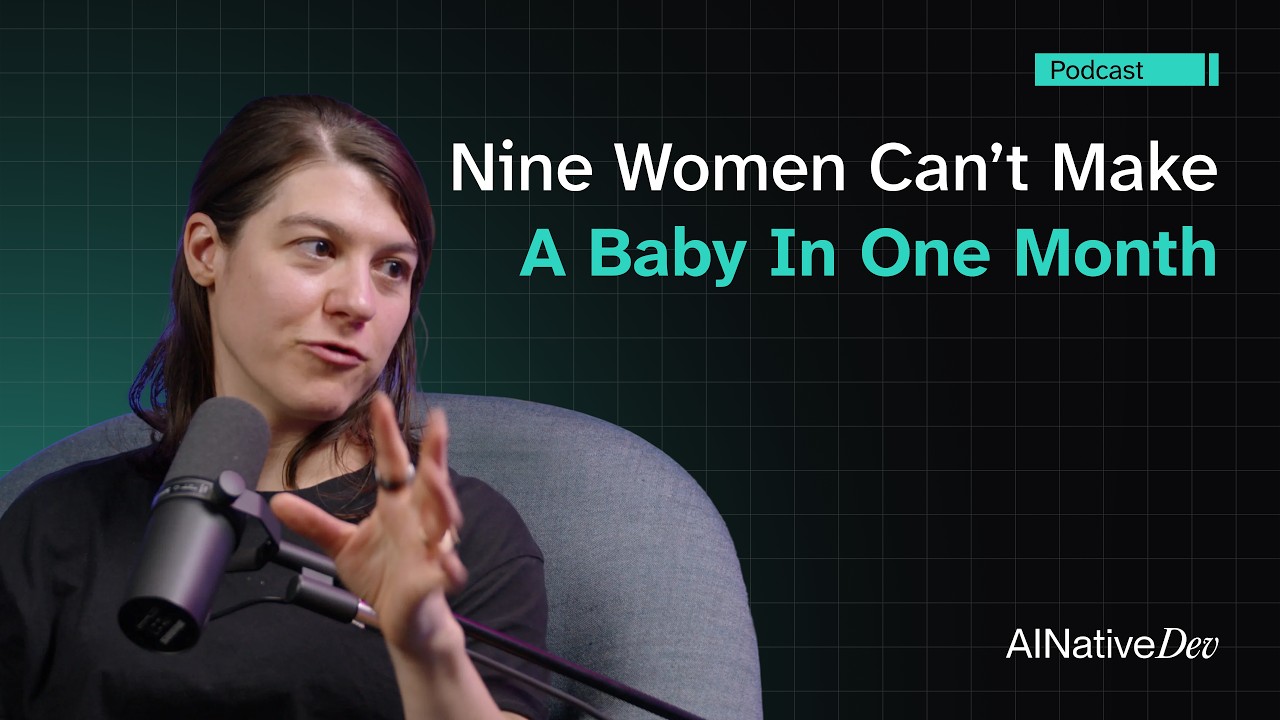
Maggie Appleton: Agentic Coding Has Outgrown the Text Box
Summary
The discussion argues that agentic coding is rapidly evolving beyond simple, text-based CLI interactions. To scale effectively, agents must become proactive collaborators, moving from merely responding to prompts to initiating research and suggesting complex solutions. Key bottlenecks identified include agents' lack of visual reasoning and the inadequacy of text-heavy 'boundary objects' (like `AGENTS.md` files) for complex, multi-stakeholder planning. The future of development requires highly interactive, visual, and structured planning environments, coupled with formal verification methods to ensure quality and reliable handoffs between human and agent work.
Key takeaways
-
Agents must be proactive, not reactive.
20:30
Agents should be designed to prompt users and perform background research (e.g., comparing NPM libraries, researching best practices) without waiting for explicit prompts, thereby reducing human cognitive load. (Transcript segment discussing proactive agents)
-
Visual reasoning is a critical AI bottleneck.
25:50
Current LLMs are primarily trained on language and code, making them weak at visual reasoning, aesthetics, and understanding spatial relationships (e.g., contrast, grouping). This limits their ability to replicate the design process of a human designer. (Transcript segment discussing visual inputs)
-
Boundary objects must become interactive and visual.
20:16
Current text-based artifacts (like `AGENTS.md` files) are poor boundary objects for collaboration. Effective tools must be social, real-time, and interactive (e.g., whiteboards, mock-ups) to facilitate complex planning among humans and agents. (Transcript segment discussing boundary objects)
-
Formal verification is key for reliable handoffs.
38:20
To mitigate risks during agentic runs, the process must move toward formal specification and verification. This allows comparing the final implementation against a rigorous, machine-readable spec, rather than relying solely on free-form natural language plans. (Transcript segment discussing formal verification)
More digests on Agentic Coding
Technical details
-
Chopin (GitHub Next Prototype)
214s
A prototype designed for multiplayer planning, allowing multiple agents to collaborate on a plan, moving work from initial planning through to a finished product. It emphasizes collaborative planning and rich, visual artifacts. (Transcript segment discussing Chopin)
-
Boundary Objects
1216s
Sociological concept applied to AI: effective artifacts (like specimens, maps, or specialized files) that enable disparate groups (humans, agents) with different worldviews to collaborate. The goal is to create interactive, visual objects, not just text files. (Transcript segment discussing boundary objects)
-
Agentic Workflow & Software Factories
170s
The concept of autonomous agents running continuous, background work (e.g., bug fixing, research) to improve quality and speed. The goal is to make the process of building software cheaper and more automated. (Transcript segment discussing software factories)
-
Spec-Driven Development
2300s
A development methodology where the plan or specification is treated as the primary artifact, which is then computationally verified against the final implementation. This is seen as an inevitable direction for complex agentic runs. (Transcript segment discussing spec-driven development)
Mentioned resources
- GitHub Next
- Chopin
- Tessl
Channel & topics
Watch on YouTube · Back to latest
This independent, AI-assisted summary is provided for commentary and informational purposes. It may contain errors or omit important context. Please watch the original video for the creator's complete presentation. Video, thumbnail, and related copyrights belong to their respective owners.