Let's Open Source the World — Brandon Thomas, ArtCraft
Summary
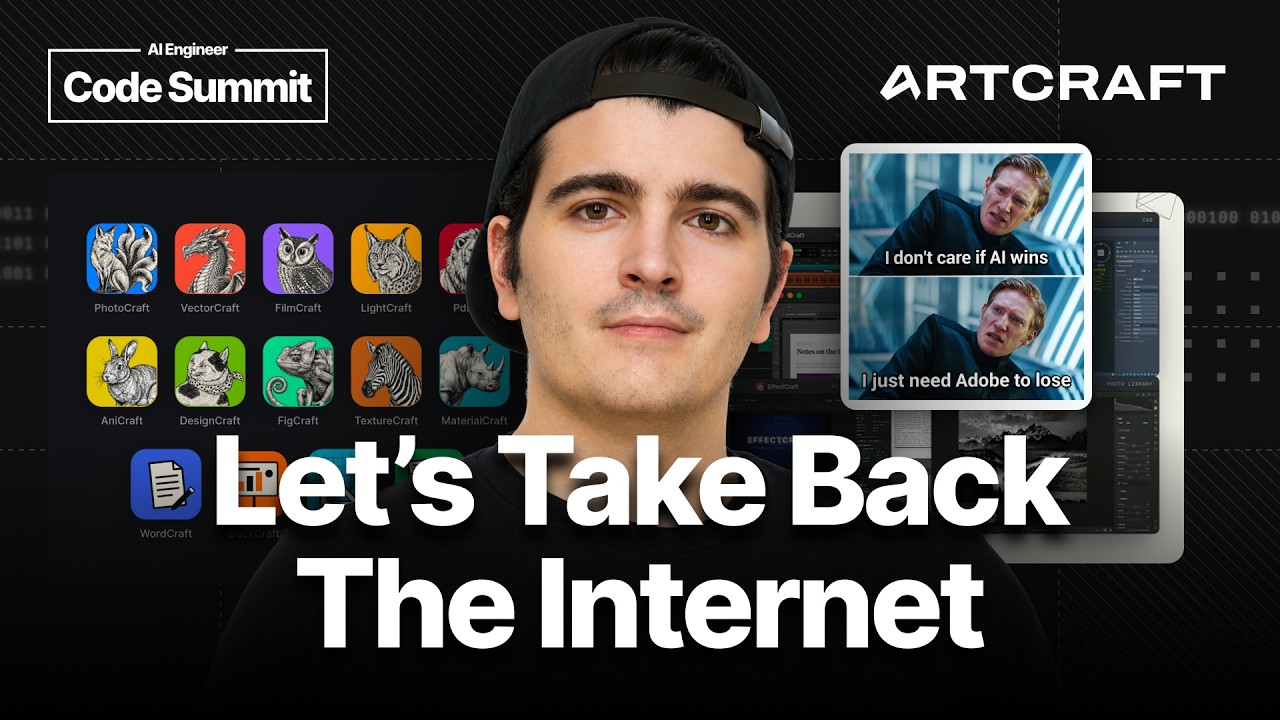
The talk advocates for 'open-sourcing the world' by building open-source alternatives to proprietary creative and office suites (like Adobe and Microsoft). Using technologies such as Rust and AI coding agents, the speaker demonstrated the ability to create a functional approximation of Photoshop within 24 hours. The core mission is to return control to users by making applications, infrastructure, and protocols open, addressing issues of data ownership, subscription gatekeeping, and the limitations of Web 2.0 platforms.
Key takeaways
-
The Shift from Protocols to Platforms
7:09
The speaker argues that the modern web has transitioned from open protocols (like early APIs) to closed platforms, leading to gatekeeping and extractive business models (e.g., mandatory subscriptions and high cancellation fees).
-
ArtCraft's Open-Source Ethos
15:17
ArtCraft was built with an open-source ethos, providing desktop tools that live on the user's machine, enabling artists to 'vibe code' their own workflows on top of the provided software.
-
AI-Powered Development Speed
By using large prompts and AI agents, the team built a functional approximation of Photoshop in 24 hours, demonstrating the potential for rapid, agentic development across complex applications.
-
Focus on Open Infrastructure
The project emphasizes that the entire infrastructure and data model are open source. Key components include support for Linux, localization, and making applications fully MCP (Microcontroller Protocol) and CLI compatible.
-
Autocraft: The Autonomous Software Factory
Autocraft is a forthcoming, fully open-source software factory designed to ingest issues, triage them, perform agentic development, and post-train models on all decisions, automating the development lifecycle.
More digests on Open Source Software
Technical details
-
Programming Language Choice (Rust)
Rust was chosen for its low defect rate, speed, and ability to support multiple platforms (NetBSD, tablets, WebAssembly via Wasm), making it ideal for high-quality, native creative applications.
-
Application Architecture
The focus is on making applications MCP and CLI compatible, allowing users to command and build projects programmatically, rather than relying solely on GUI interactions.
-
Agentic Development Workflow
The speaker recommends using AI agents for immutable tasks like desktop apps and games, while reserving human review for complex tasks such as backend work, schema migrations, and API design.
-
CI/CD and Infrastructure
The team has developed its own CI infrastructure, noting that the process of scaling and managing CI/CD pipelines is a significant technical challenge.
Mentioned resources
- ArtCraft
- PDF Craft
- Solid Craft
- Autocraft
Channel & topics
Watch on YouTube · Back to latest
This independent, AI-assisted summary is provided for commentary and informational purposes. It may contain errors or omit important context. Please watch the original video for the creator's complete presentation. Video, thumbnail, and related copyrights belong to their respective owners.