Inside LangChain’s GTM agent: one agent, 47 use cases
Summary
LangChain's GTM agent functions as a centralized 'operating system' for Go-To-Market (GTM) functions, managing 47 distinct use cases and providing intelligence across sales, marketing, and product teams. Built on the LangChain stack, the agent started with personalized SDR outreach and has evolved into a system that handles complex workflows like customer health scoring and generating POV decks. The architecture relies on a dispatcher and role classifier to route requests to specific Deep Agents graphs, ensuring scalability and consistency, while LangSmith Engine has been instrumental in optimizing processes, such as reducing contact enrichment costs by 40%.
Key takeaways
-
Centralization vs. Silos
30:14
The GTM agent is designed to be a single source of truth, preventing the proliferation of individual agents (like Codex or Claude Cowork) that reference the same tools, thereby ensuring that every run contributes to continuous system improvement and control [18:14].
-
Measurable Business Impact
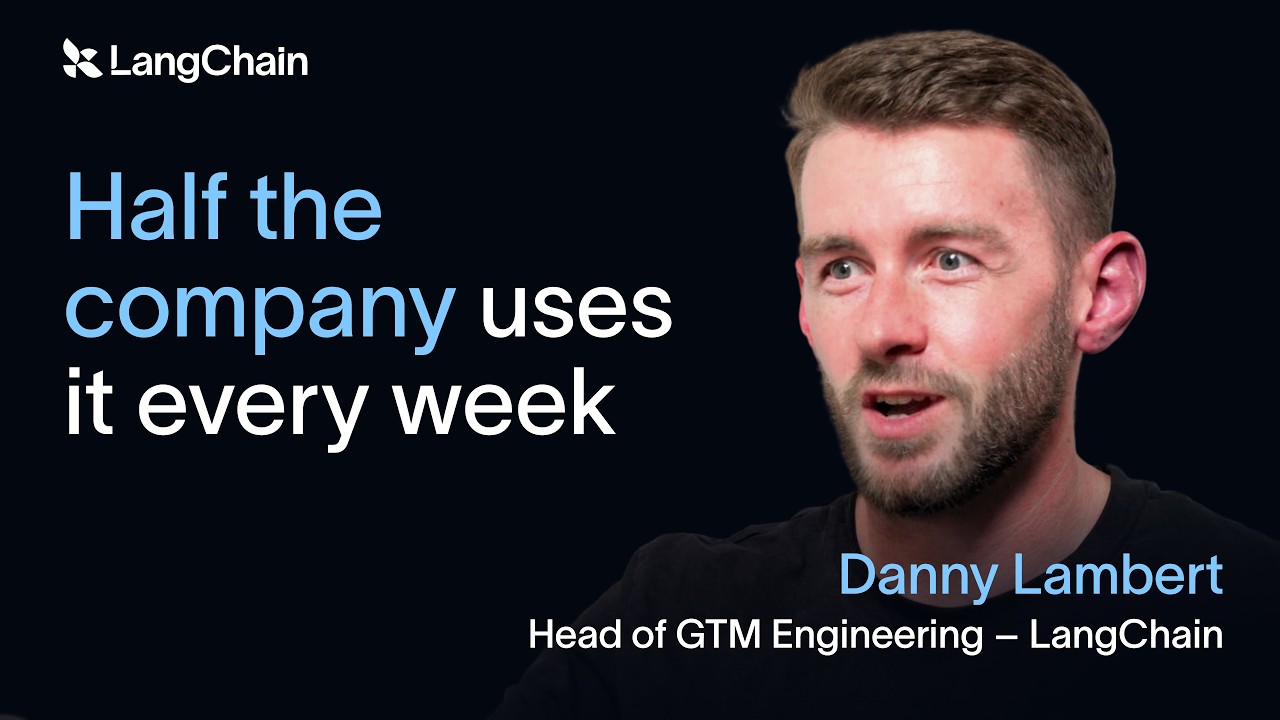
The agent drives measurable results, including 46 meetings per week, with a cost of $170 per meeting. The average time to a response drafted by the agent is 2 minutes and 42 seconds, compared to 5.5 hours for a human response [0:00].
-
Cost and Performance Optimization
36:55
LangSmith Engine was used to proactively identify and propose changes to workflows, resulting in a 40% reduction in the cost of the contact enrichment flow [22:15].
-
The Operating System Concept
10:03
The GTM agent is viewed as an 'operating system' for GTM work, synthesizing data from various sources (e.g., Gong transcripts, ad platforms) into a single, accessible context, allowing users to perform complex tasks in natural language [6:03].
Technical details
-
Agent Architecture
1814s
Requests enter the system via methods like webhook, cron, or agent UI. A dispatcher and role classifier first analyze the request (user, team, role) before it reaches the Deep Agents harness. This allows the system to dynamically select the correct subset of tools and graphs [18:14].
-
Graph Management and State
1814s
The system utilizes one large agent managing 47 different graphs for specific use cases. State persistence is critical, allowing the agent to manage and hand off tasks (e.g., scheduling an email) to a different subgraph that runs on a scheduled cron, ensuring continuity [18:14].
-
Observability and Improvement
2045s
LangSmith traces are used to monitor user interaction, identify common failure modes, and cluster usage patterns. This data drives the product roadmap, allowing the team to be proactive about fixing 'silent failures' and user frustration [20:45].
-
Specialized Agents
2620s
Beyond the core GTM agent, the team maintains specialized systems like the Paid Media Agent (monitoring six ad platforms and performing Q&A) and Content Studio (a multimedia generation tool capable of creating video, audio, and PNGs [26:20]).
Mentioned resources
Channel & topics
Watch on YouTube · Back to latest
This independent, AI-assisted summary is provided for commentary and informational purposes. It may contain errors or omit important context. Please watch the original video for the creator's complete presentation. Video, thumbnail, and related copyrights belong to their respective owners.