How Workday Builds Agent Prototypes in Under a Day with LangChain
Summary
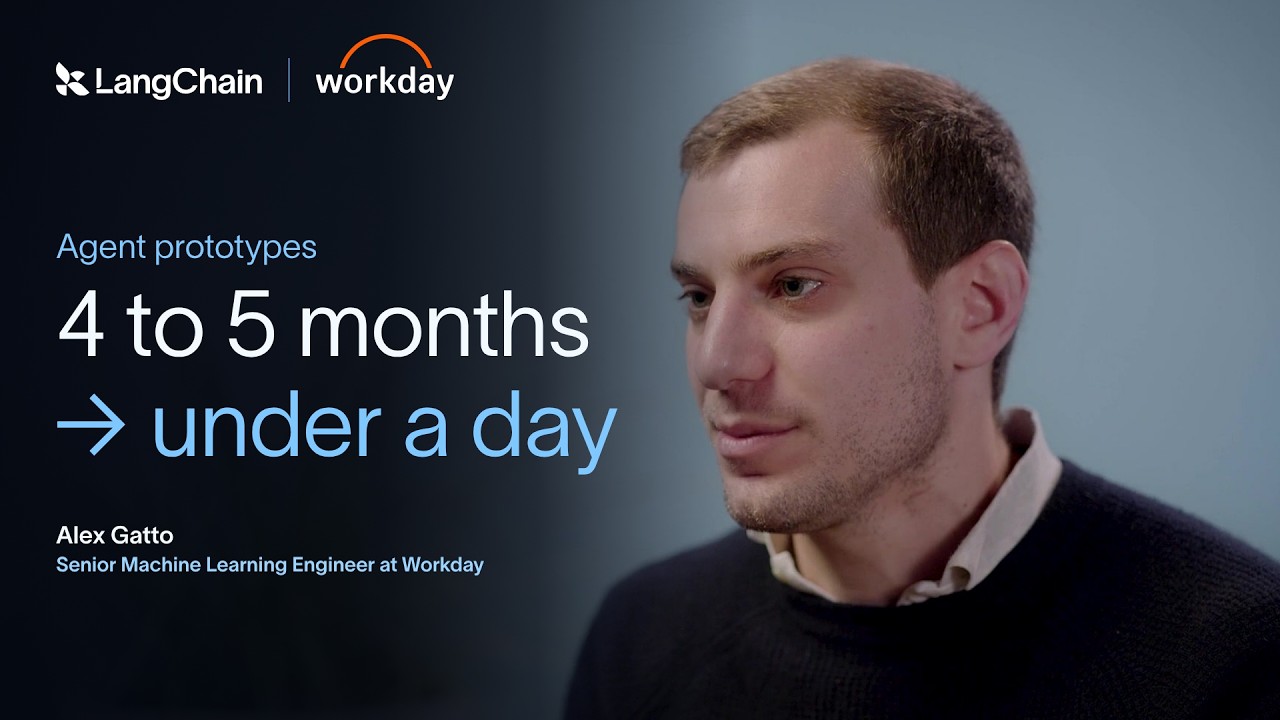
Workday, an HR and financials company, built an internal agent platform to streamline the development and deployment of AI agents for large enterprises. By partnering with LangChain, the team was able to drastically reduce the time required to move agent prototypes to staging—from 4 to 5 months to less than a day. The platform handles complex enterprise requirements like authentication and security by running agents as A2A and MCP servers, allowing internal teams to focus solely on defining the agent's functional graph (e.g., ReAct loop or deterministic workflow).
Key takeaways
-
Accelerated Agent Development Cycle
3:37
The platform reduced the time required to get an agent prototype to staging from 4 to 5 months to less than a day. This speed is critical for achieving goals of 50 to 100 agents in production and over a million active users by year-end.
-
Built-in Enterprise Security
2:04
All agents on the platform run as A2A and MCP servers, with authentication and security requirements baked in. This allows internal teams to bypass complex infrastructure setup and focus only on the agent's logic and graph structure.
-
Focus on Function, Not Infrastructure
3:37
The platform abstracts away infrastructure concerns, meaning developers only need to worry about the agent's function and how to build its graph (e.g., ReAct loop or deterministic workflow).
Technical details
-
Agent Deployment Architecture
124s
The platform enables agents to run as both A2A (Application-to-Application) and MCP (Microservice Client Protocol) servers, ensuring that authentication and security are handled natively.
-
Platform Components
55s
The solution utilizes LangChain's Agent Server and LangSmith, providing an end-to-end package that includes observability and evaluation tools, which the team noted was essential for rapid development.
-
Agent Graph Design
217s
Developers are responsible for defining the agent's functional graph, which can take the form of a ReAct loop or a deterministic workflow.
Mentioned resources
Channel & topics
Watch on YouTube · Back to latest
This independent, AI-assisted summary is provided for commentary and informational purposes. It may contain errors or omit important context. Please watch the original video for the creator's complete presentation. Video, thumbnail, and related copyrights belong to their respective owners.