How to Ship Millions of Lines of Agent-Written Code — Jarred Sumner, Anthropic
Summary
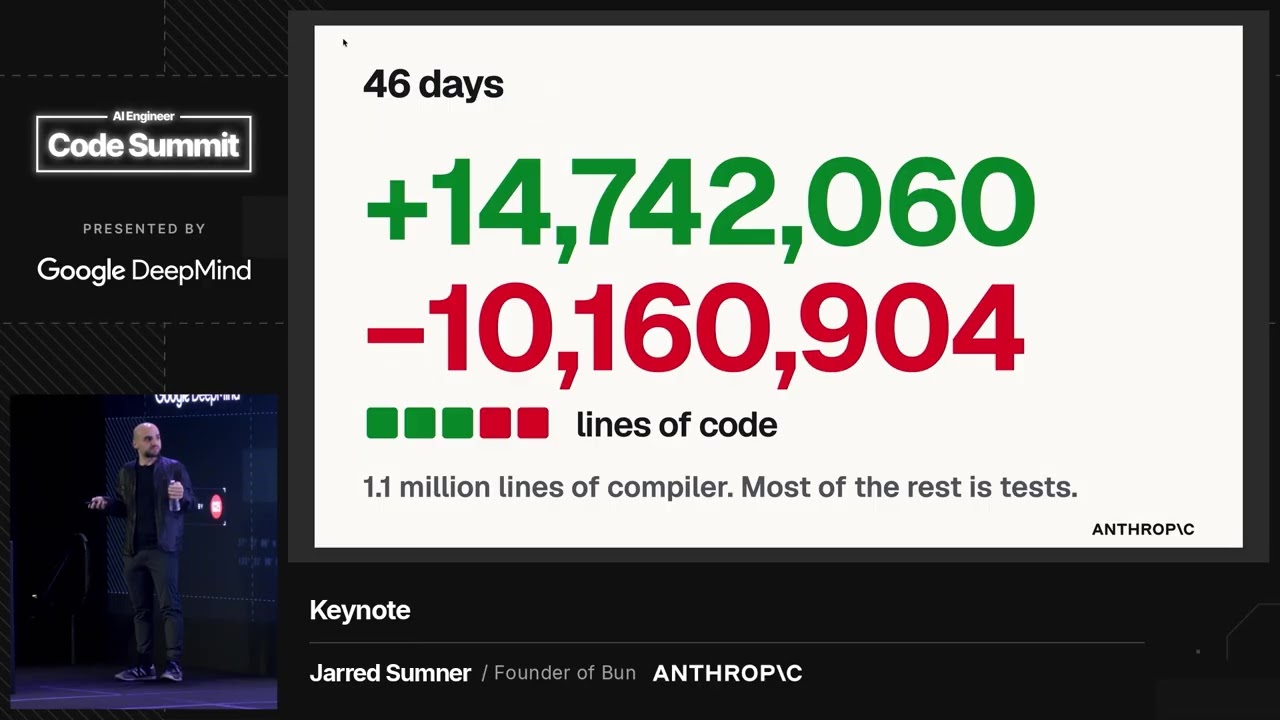
Jarred Sumner, creator of Bun, details the process of shipping a multi-million line code base generated by AI agents. The project introduced an Ahead-of-Time (AOT) compiler to Bun, the runtime behind Claude Code, resulting in a 4x reduction in memory usage and a 2x faster startup time. The speaker emphasizes that the success of this massive project hinges not on the coding approach, but on the robustness of pre-existing tests, which are used to verify the trustworthiness of agent-written code.
Key takeaways
-
Testing Dictates Approach
3:47
The project's approach was driven by the need to verify functionality and ensure reliability, making testing more critical than the specific implementation strategy (2:27).
-
AOT vs. JIT for Performance
4:57
The AOT compiler was implemented to reduce the CPU time typically spent compiling code on demand (JIT), which is particularly critical for applications like Cloud Code (3:57).
-
Agent Workflow Management
15:12
The development cycle involves writing code in large batches, followed by dedicated fixing and testing phases. Long-lived subagents are used for maintenance and context retention (9:12, 15:21).
-
Trusting Pre-existing Tests
10:57
The primary mechanism for ensuring code quality is relying on tests that predate the project, which provides a level of trust that is difficult to achieve when rewriting codebases (6:57).
More digests on AI Engineering
Technical details
-
AOT Compiler Implementation
442s
The AOT compiler was merged via a multi-million line PR to Bun, aiming to replace the runtime cost of JIT compilation. The resulting code uses 4x less memory and starts 2x faster (0:00, 4:42).
-
Type Handling
612s
In the AOT process, TypeScript types are treated as 'predictions' rather than absolute truths, which is noted as being effective for models that write compilers (6:12).
-
Verification and Fuzzing
Verification involves running three versions of an application (JIT, AOT, no types) and using tools like V8 Zilly, extended to test TypeScript types, to fuzz patterns and catch bugs (8:27, 16:51).
-
Breaking Changes
827s
The AOT compiler introduced two breaking changes, primarily related to security measures designed to prevent prototype pollution attacks, which also benefited performance (8:27).
Mentioned resources
Channel & topics
Watch on YouTube · Back to latest
This independent, AI-assisted summary is provided for commentary and informational purposes. It may contain errors or omit important context. Please watch the original video for the creator's complete presentation. Video, thumbnail, and related copyrights belong to their respective owners.