How to Fine-Tune Models Beyond Cosmos With NVIDIA Cosmos Framework
Summary
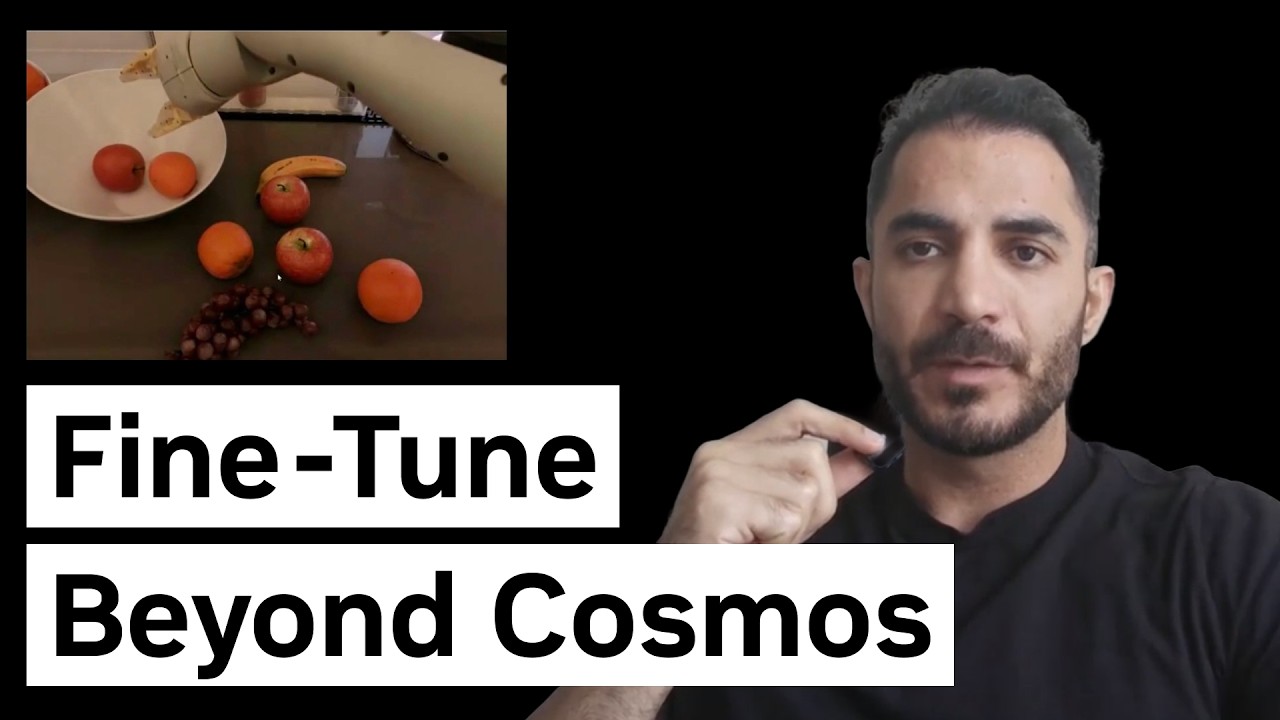
This tutorial demonstrates the use of the NVIDIA Cosmos Framework to fine-tune models beyond the Cosmos family, specifically Qwen3-VL, for robot video question answering (RoboVQA). The process is fully automated by a coding agent, which executes a defined skill workflow—including setup, data download, preflight checks, baseline evaluation, training (1 epoch), and post-training scoring—on an NVIDIA GB300. The fine-tuned model showed improved performance on a held-out clip.
Key takeaways
-
Non-Cosmos Model Fine-Tuning
The Cosmos Framework supports training models outside the Cosmos family, demonstrated here with Qwen3-VL using the RoboVQA dataset.
-
Agent-Driven Workflow Execution
4:13
A coding agent can execute the entire fine-tuning process (setup, download, pre-flight, training, scoring) from a single prompt by utilizing the defined skill.
-
Training and Evaluation Results
The post-training accuracy was reported as 62.8% (within a 62-63% range), showing improvement over the base model when tested on a held-out robot video clip.
Technical details
-
Model and Hardware Specifications
0s
The fine-tuning utilized Qwen3-VL and was executed on an NVIDIA GB300, with the demonstrated training run taking approximately two hours.
-
Cosmos Skill Workflow
135s
The 'Cosmos 3 Qwen3-VL RoboVQA SFT' skill manages a sequence of steps: setup, download, pre-flight, baseline scoring, training, and post-training scoring.
-
Fine-Tuning Methodology
0s
The process involves Supervised Fine-Tuning (SFT) using the RoboVQA dataset to improve the model's ability to answer questions about robot videos.
Mentioned resources
Channel & topics
Watch on YouTube · Back to latest
This independent, AI-assisted summary is provided for commentary and informational purposes. It may contain errors or omit important context. Please watch the original video for the creator's complete presentation. Video, thumbnail, and related copyrights belong to their respective owners.