How Netflix Evaluates AI When There's No Right Answer - Cameron Wolfe, Netflix
Summary
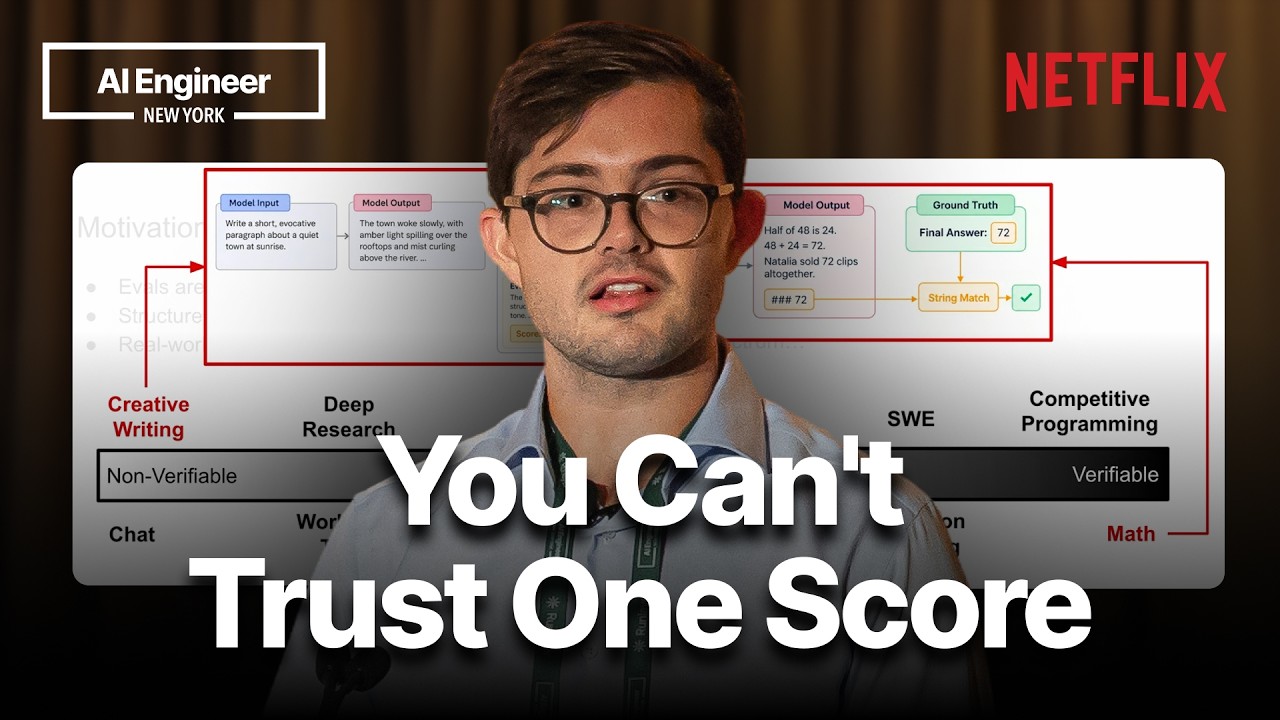
Cameron Wolfe outlines a robust, multi-stage framework for evaluating highly subjective tasks, such as creative writing, where traditional deterministic pass/fail checks are insufficient. The process establishes human evaluation as the 'North Star' for defining quality. This standard is then scaled using LLM judges or rubrics as automatic proxies, which must be validated through meta-evaluation against human 'golden data.' Finally, the system is closed by using A/B testing and production monitoring to confirm performance gains in the real world, all while employing advanced statistical techniques (like power analysis and resampling) to mitigate noise and ensure reliable conclusions.
Key takeaways
-
The Three-Part Evaluation Framework
5:54
The process requires three components: 1) Human evaluation (the North Star) for defining quality; 2) Offline evaluation using LLM judges or rubrics to scale testing; and 3) Production monitoring and A/B testing to validate results in a live environment (3:54, 13:17).
-
Mitigating Noise and Subjectivity
Because evaluation involves multiple non-deterministic components (agents, LLMs), noise is inherent. Statistical techniques like power analysis, error bars, and resampling are necessary to provide clear confidence signals and ensure observed performance improvements are legitimate (11:45).
-
Scaling Evaluation with LLM Judges and Rubrics
15:47
To move beyond human bottlenecks, LLM judges provide high-level quality guideline checks, while rubrics offer a more objective, task-specific checklist for independent verification of individual items (9:47).
-
The Importance of Production Monitoring
The final step is using production metrics (e.g., abandonment rate, explicit feedback) and A/B testing to vet the model's quality in a live setting, ensuring the model performs well before full rollout (13:17).
Technical details
-
Evaluation Challenges
243s
Evaluating subjective tasks is difficult due to non-deterministic agents and components, which introduce significant noise and fluctuations in results (2:43).
-
Power Analysis
605s
This statistical concept helps determine the minimum volume of data required for an evaluation to draw a meaningful conclusion about the difference in performance between two models, based on desired effect size and noise level (6:05).
-
LLM Judges vs. Rubrics
947s
LLM judges are given high-level quality guidelines, similar to human evaluation. Rubrics are more specific, defining a task-specific checklist where each item is verified independently (9:47).
-
Meta-evaluation
947s
This process is required to ensure the accuracy of automatic judges/rubrics. It involves measuring the agreement between the judge's output and a 'golden data' set derived from confident human evaluations (9:47).
Mentioned resources
- Deep (Learning) Focus newsletter
- AIE CODE summit
Channel & topics
Watch on YouTube · Back to latest
This independent, AI-assisted summary is provided for commentary and informational purposes. It may contain errors or omit important context. Please watch the original video for the creator's complete presentation. Video, thumbnail, and related copyrights belong to their respective owners.