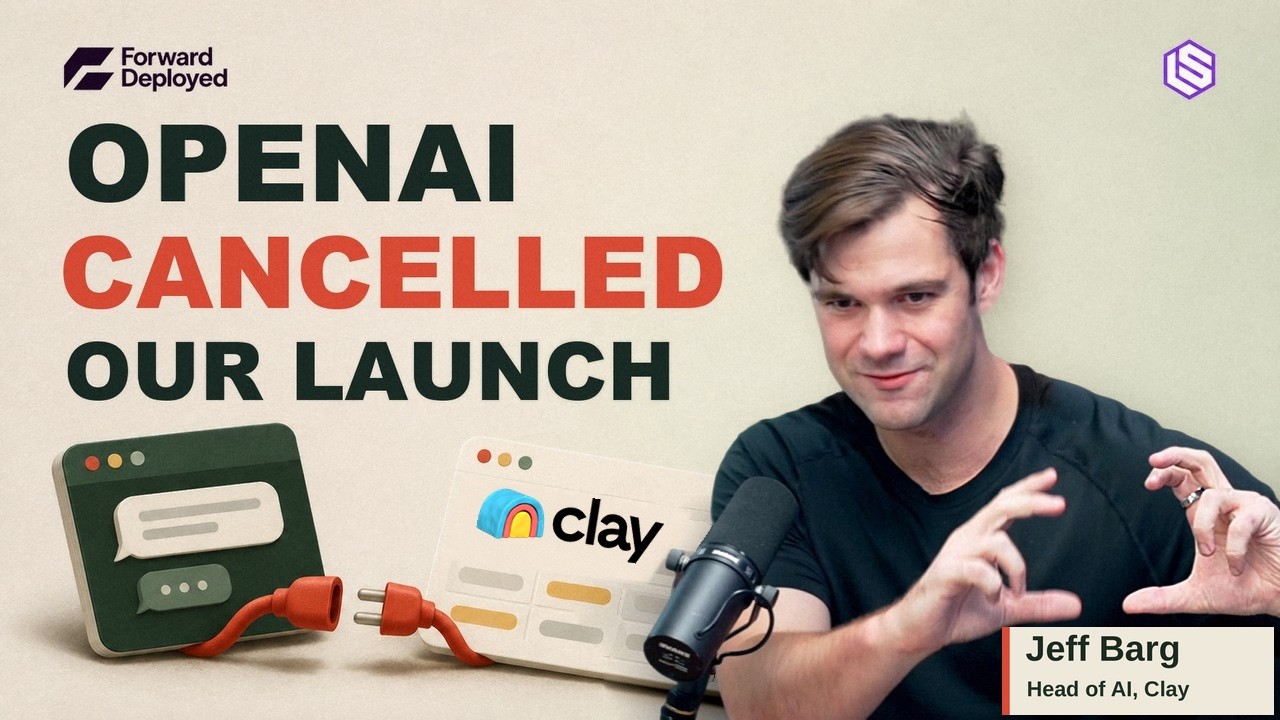
How Clay Builds GTM Agents — Jeff Barg, Head of AI
Summary
Clay, a GTM platform, is evolving from a low-code spreadsheet tool to a sophisticated, agentic infrastructure. The company emphasizes that its agents are designed not to be markedly better than using Clay alongside external harnesses like Claude Code, leading to a near 50/50 usage split. Engineering efforts focus heavily on building robust, hand-rolled systems, advanced data context layers, and sophisticated agent tooling (like the CLI), rather than relying solely on frontier model performance. The company is actively developing a model router and focusing on the operational challenges of scaling inference workloads.
Key takeaways
-
Agentic Shift: From Cells to Workflows
40:49
Clay rebuilt its agent infrastructure around a coding agent (Sculptor), moving beyond simple data extraction to building complex GTM workflows. Clay Agents are designed to perform tasks that previously required human sales reps, such as categorization and lead enrichment.
-
The Limits of Current Agents
56:56
Despite advancements, agents still struggle with basic tasks, such as repeatedly trying CLI commands with the same inputs without correction. The company is actively working on agent self-reflection and debugging capabilities.
-
Post-Training Viability Threshold
45:48
Jeff Barg's bar for when post-training or open-weight models pay off is reaching a substantial inference spend, specifically between $10M and $100M.
-
Competitive Parity and Customer Preference
54:00
Clay explicitly does not want its agent to be marketed as markedly better than using Clay + Claude Code. Usage is reported to be close to 50/50 between Clay's agent and outside harnesses, which customers seem to prefer.
More digests on AI Engineering
Technical details
-
Agent Architecture and Tooling
4000s
The platform utilizes a CLI (Command Line Interface) and a cloud sandbox to expose all Clay primitives to the agent. The system is described as a 'proper coding agent,' moving beyond simple tool loops.
-
Infrastructure and Reliability
4130s
The agent durability and orchestration rely heavily on hand-rolled systems, primarily built on BullMQ (JavaScript). The company does not currently use LangGraph or Temporal for orchestration.
-
Inference Workload Management
4230s
Inference workloads are described as 'quite spiky' when running agents across large datasets (e.g., 50,000 companies). Significant effort was spent on throttling and ensuring failover capabilities in case an inference provider goes down or rate limits are hit.
-
Data Context and Knowledge Graph
4100s
The platform maintains a core data context layer, which combines CRM data, Gong data, and entity resolution into an 'authoritative canonical spreadsheet' for customers and contacts.
Mentioned resources
- Clay
- Claude Code
- BullMQ
- Sculptor
- LangGraph
Channel & topics
Watch on YouTube · Back to latest
This independent, AI-assisted summary is provided for commentary and informational purposes. It may contain errors or omit important context. Please watch the original video for the creator's complete presentation. Video, thumbnail, and related copyrights belong to their respective owners.