Building a Commercial Submission Intake Workflow with LlamaParse
Summary
This webinar details a comprehensive, end-to-end workflow for processing commercial submission intake documents, designed to automate manual data entry and reconciliation. The system, built using LlamaIndex's suite of document AI solutions, ingests multiple file types (e.g., PDFs, Excel sheets) from an initial email submission. The process involves classifying, splitting, parsing, and extracting specific data points, while also running verification checks for document manipulation or discrepancies. The output is a structured context layer that feeds into deterministic and AI-driven checks, flagging exceptions for human review before the data is synchronized into a data warehouse like Snowflake.
Key takeaways
-
Automated Document Ingestion and Context Building
20:00
The workflow handles multiple document types and components (e.g., Accord 125 and Accord 140) by classifying, splitting, parsing, and extracting data. This creates a strong, structured context layer that feeds both deterministic and AI checks, minimizing manual data handling.
-
Discrepancy and Exception Handling
25:00
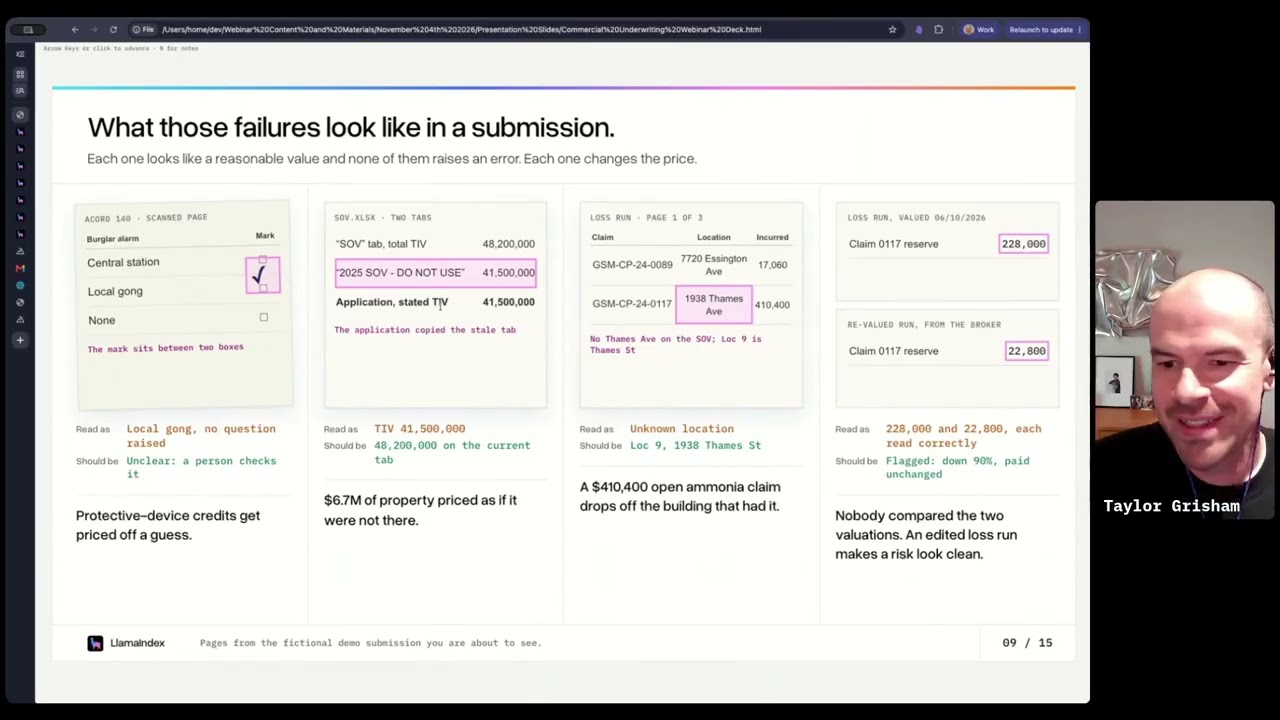
The system identifies discrepancies (e.g., Total Insured Value (TIV) mismatch) and flags issues (e.g., missing loss history, outdated documents) in a dedicated 'exceptions view.' This ensures human reviewers only focus on problematic data points, rather than reviewing entire documents.
-
Multi-Modal and Cross-Document Verification
25:50
The Verify solution checks for subtle signs of document manipulation or modification. Furthermore, the system can compare the same facts (e.g., addresses, values) across multiple disparate documents to identify inconsistencies.
-
Integration with Modern AI Tools
33:20
The workflow can be executed through a dedicated application interface or integrated into AI assistants (like Claude via an MCP server), allowing the same robust data processing to occur within the tools commonly used by underwriters.
Technical details
-
LlamaIndex Document AI Suite
300s
The core solutions include: <ul><li>**Parse:** Converts over 130 file types into structured AI data (e.g., Markdown, JSON). It offers different tiers (Aigentic Plus, Aigentic, Fast Mode) to balance accuracy and cost based on document complexity (e.g., degraded, scanned documents).</li><li>**Extract:** Pulls specific, targeted values from a document based on a defined schema (which can be defined via interface or JSON).</li><li>**Split:** Takes a single document and splits it into granular components (e.g., separating multiple forms into individual pages).</li><li>**Classify:** Determines the type of a single document (e.g., identifying a 'loss run') and provides a confidence score and reasoning.</li><li>**Verify:** Analyzes documents to detect signs of manipulation or alteration.</li></ul>
-
Data Processing and Output
2200s
The process is designed to provide high traceability: all extracted information includes bounding boxes and confidence scores, allowing human reviewers to pinpoint the exact source of the data. The final, reconciled data is exported to a data warehouse (e.g., Snowflake) and can be updated without duplicating records.
-
Workflow Architecture
1300s
The system operates by building a 'strong context layer' through a sequence of steps: Classification $\rightarrow$ Splitting $\rightarrow$ Parsing $\rightarrow$ Extracting $\rightarrow$ Verification. The final decision-making layer combines deterministic checks and AI checks, with human intervention reserved only for flagged exceptions.
Mentioned resources
- LlamaIndex Playground
- ParseBench / ExtractBench
Channel & topics
Watch on YouTube · Back to latest
This independent, AI-assisted summary is provided for commentary and informational purposes. It may contain errors or omit important context. Please watch the original video for the creator's complete presentation. Video, thumbnail, and related copyrights belong to their respective owners.