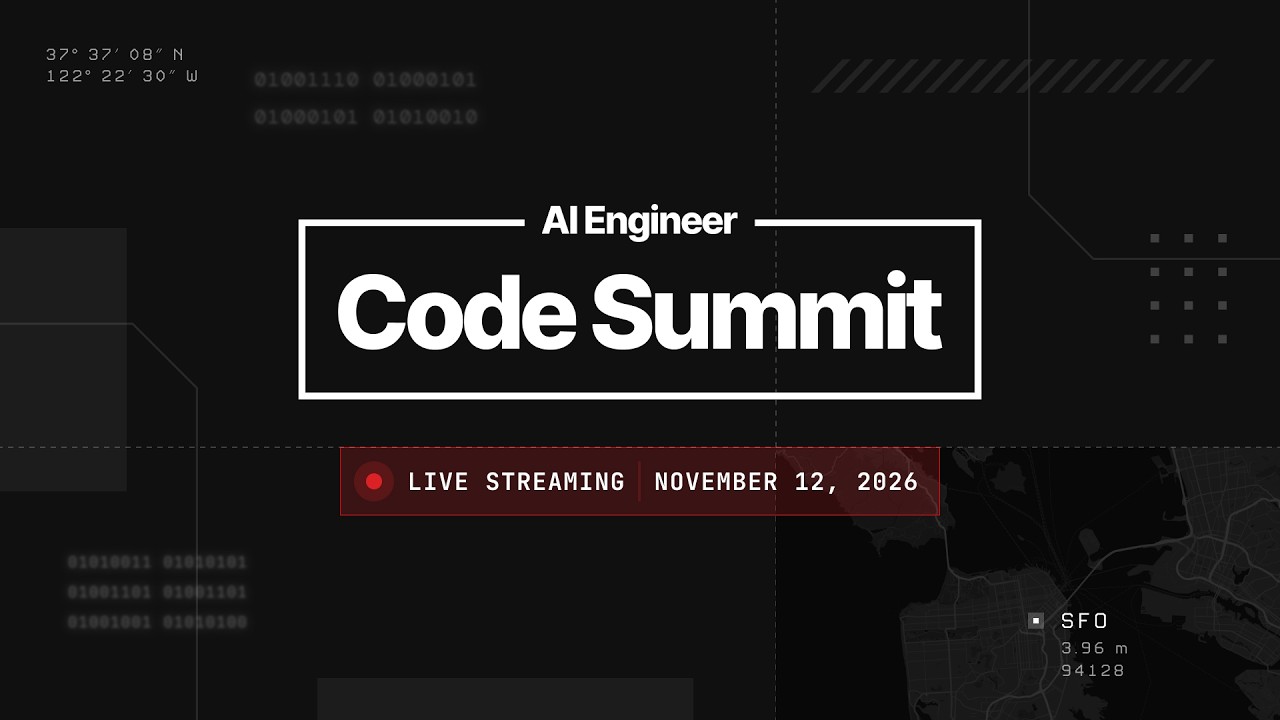
AIE CODE: OpenAI, ArtCraft, Cognition, Exa, Anthropic, Amp, et al
Summary
The future of software engineering is shifting from writing code to building and engineering systems that write code. Multiple speakers presented models for 'Software Factory Engineering,' defining a factory as a declarative, closed-loop system for continuously measuring and improving AI coding agents. Key technical focus areas include establishing open protocols (MCP/CLI-first), ensuring data integrity in agent outputs (e.g., structured JSON/compact output), and implementing robust CI/CD practices for agentic workflows, such as self-improvement loops and benchmarking.
Key takeaways
-
Ambition and Ownership in AI
18:10
True ambition in AI is not about increasing token usage, but about developing the language and critical judgment to describe what 'good' looks like. Developers must maintain ownership of the work, acting as active participants rather than passive observers of AI-generated 'slop.'
-
The Workshop vs. The Factory
23:50
Focus on building the 'artiller' or 'workshop' (the process and tools) before building the automated 'software factory.' Model improvements (e.g., using the latest models) are dramatically increasing agent capability without requiring changes to the core harness functionality.
-
Defining the Software Factory
38:20
A software factory is defined as a 'code defined closed loop system for continuously measuring and improving cloud coding agents.' This requires encoding the entire workflow in a declarative language (like Terraform) and establishing continuous measurement and improvement loops.
-
Agent Output Reliability and CLI Design
50:00
Agents often fail by relying on simple piping (`|`) or assuming the answer's location. To improve reliability, tools must 'fail loudly,' provide structured output (e.g., JSON, compact mode), and expose flags/skills to guide the agent's search process.
-
The Importance of Open Protocols and Native Code
41:40
To combat proprietary 'extractive' models, the trend is toward open-source, MCP (Micro-Component Protocol) and CLI-first applications. Languages like Rust are favored for their memory safety and ability to deploy natively across multiple platforms.
More digests on AI Engineering
Technical details
-
Software Factory Architecture
2300s
The ideal factory infrastructure stack includes: 1) Factories as Code (declarative definition); 2) Data/Context Layer (recording all agent conversations and artifacts); 3) Compute Layer (sandboxing for security/repeatability); 4) Inference Layer (supporting multiple models/harnesses); 5) Orchestration Layer; and 6) API/MCP-first design (integrating with Jira, GitHub, etc.).
-
Agent Improvement Loops
2300s
Continuous improvement requires setting up online evals (having one agent score the output of another) and running benchmarks on proprietary data to test model/harness/factory configurations against real-world failure modes.
-
Agent Session Data Management
3000s
Tools like `tapes.dev` are used to collect and manage agent session data, which serves as the primary source of 'product analytics' for identifying friction points and improving tool design.
-
CLI Best Practices for Agents
3000s
When designing CLIs for agents, implement features like 'compact mode' (e.g., JSON output) and use specific flags/skills to guide the agent, rather than relying solely on pipes, which can cut critical information.
Mentioned resources
- OpenAI
- Google DeepMind
- Arendelle (PI coding agent)
- Warp
- Artcraft
- Rust
- MCP (Micro-Component Protocol)
- Terraform
- tapes.dev
Channel & topics
Watch on YouTube · Back to latest
This independent, AI-assisted summary is provided for commentary and informational purposes. It may contain errors or omit important context. Please watch the original video for the creator's complete presentation. Video, thumbnail, and related copyrights belong to their respective owners.