7 Things Your AI Coworker Needs - Philipp Schmid, Google DeepMind
Summary
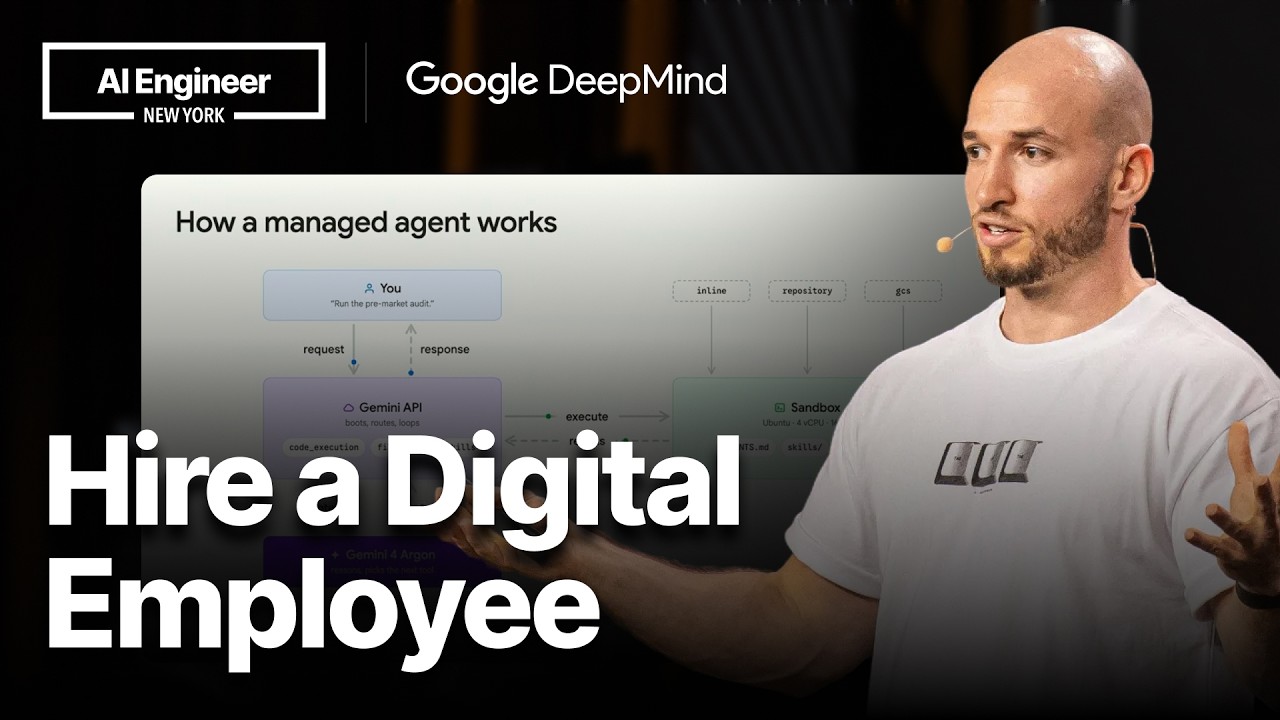
Philipp Schmid details the architecture for building autonomous AI coworkers using Gemini and Managed Agents. The system is designed to function as a digital employee, requiring seven core components: a brain (Gemini), a computer (Managed Agents sandbox), playbooks (skills), tools (MCP servers), secure credentials, house rules (hooks), and schedules (triggers). The use of a network proxy for credentials and deterministic hooks significantly enhances security and control, allowing the agent to perform complex, scheduled tasks like automated portfolio audits.
Key takeaways
-
Autonomous Agent Architecture
2:05
An AI coworker requires seven components: a brain, a computer, playbooks, tools, credentials, house rules, and a schedule. Managed Agents provide the necessary remote sandbox for the agent to run code and tools.
-
Managed Agents for Sandboxing
7:09
Managed Agents simplify agent creation by providing a remote sandbox, eliminating the complex tool-calling loop. The agent can execute code (e.g., writing a file) directly via an API call within the managed environment.
-
Enhanced Security with Network Proxy
15:57
Credentials are secured using an external network proxy. This proxy swaps dummy credentials with real ones only for explicitly defined domains, making it impossible for a prompt injection attack to steal sensitive keys.
-
Deterministic Guardrails via Hooks
Hooks allow for deterministic control over the agent's decisions. By defining a matcher (regex) on tool calls, human approval can be required for specific actions, ensuring compliance and safety.
More digests on Autonomous Agents
Technical details
-
Gemini Model Capabilities
250s
Gemini 4 Argon offers up to 1 million unified context tokens, with strong improvements in math and reasoning, providing more than 64K tokens for complex thinking and proof work.
-
Managed Agents Implementation
531s
To create an agent (e.g., 'Bug'), one defines the agent ID, uses the agent harness, and specifies the model. The environment can be bootstrapped using skills defined in an `agents.md` file or a connected GCS bucket.
-
Tooling and Integration
847s
Tools include built-in skills (Google Search), or external services accessed via an MCP server (e.g., Gmail, Spreadsheets). Custom functions can be provided for agentic capabilities outside the sandbox.
-
Scheduling and Triggers
Agents can be made proactive using basic cron triggers (e.g., running an audit every 30 days at 8:00 a.m.). Webhooks are also supported for connecting external services (like SAC providers) to trigger agent actions.
Mentioned resources
- Gemini API
- Managed Agents
- AI Studio
- Gemini 4 Argon
Channel & topics
Watch on YouTube · Back to latest
This independent, AI-assisted summary is provided for commentary and informational purposes. It may contain errors or omit important context. Please watch the original video for the creator's complete presentation. Video, thumbnail, and related copyrights belong to their respective owners.