4 Types of AI Agent Loops: From Human-Led to Autonomous
Summary
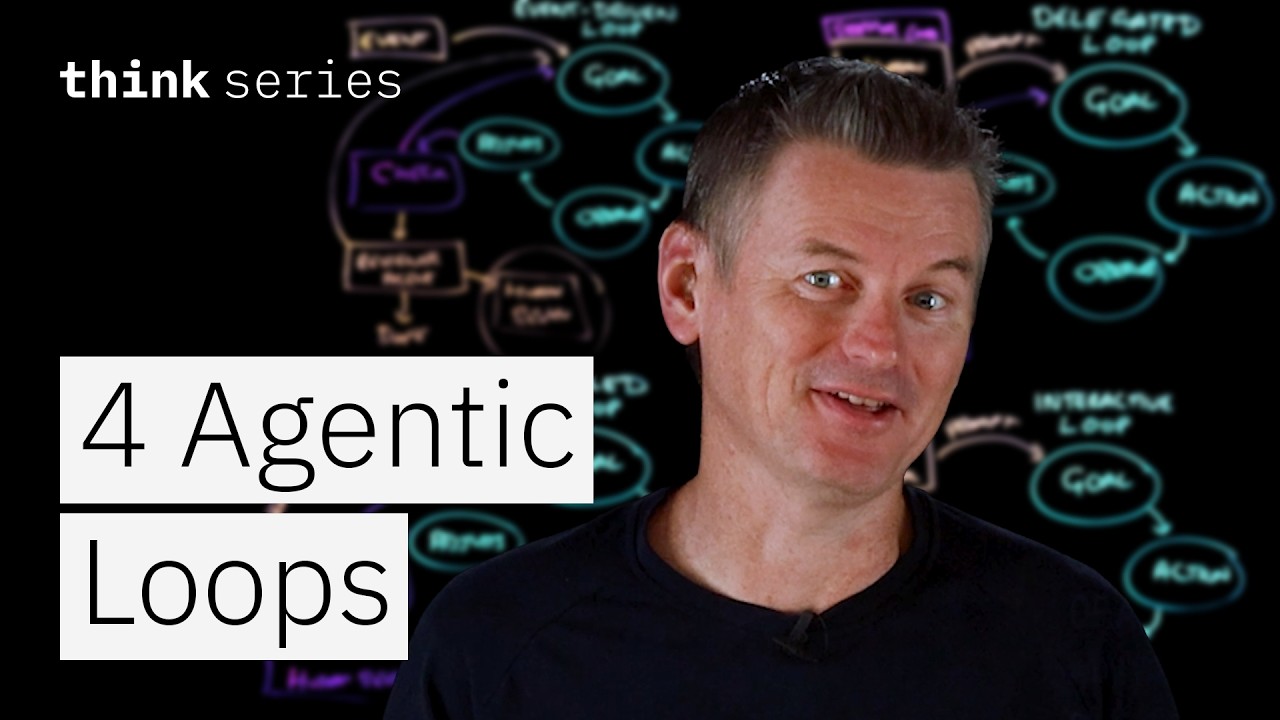
This video details four types of AI agent loops—interactive, delegated, scheduled, and event-driven—which define the level of autonomy in agentic workflows. All loops follow a basic cycle (Goal, Action, Observe, Adjust), but they differ in who sets the goal and who determines the stopping condition, ranging from human-led tasks to fully autonomous systems.
Key takeaways
-
Interactive Loop (Human-Led)
The human sets the goal and judges the outcome at the end of every cycle, making it suitable for fuzzy tasks lacking a measurable finish line. This loop is difficult to scale for repetitive jobs.
-
Delegated Loop (AI-Judged)
5:30
The human sets the goal with a specific stopping condition, which is judged by an AI check. The agent runs until the condition is met, after which the result is provided for human review.
-
Scheduled Loop (Time-Driven)
8:37
The loop is initiated by a clock, not a person. It uses an AI check to judge the stopping condition, making it ideal for recurrent or time-sensitive tasks, such as managing out-of-date libraries.
-
Event-Driven Loop (Autonomous)
The loop is triggered by an external event (e.g., a pull request). It uses a second, dedicated reviewer agent to check the stopping condition, with human review reserved only for exceptions.
Technical details
-
Agentic Workflow Cycle
19s
All agentic loops share the pattern: Agent takes a Goal $ ightarrow$ Performs an Action (e.g., running a command) $ ightarrow$ Observes the output $ ightarrow$ Adjusts based on observation, repeating until completion.
-
Stopping Conditions
330s
The stopping condition determines when the loop exits. In delegated and scheduled loops, this check is performed by an AI. In event-driven loops, a separate reviewer agent performs the check.
-
Human-in-the-Loop vs. AI Review
The interactive loop requires human judgment at the end of the process. The event-driven loop replaces the final human review with an AI reviewer agent, reserving human intervention only for exceptions.
Mentioned resources
Channel & topics
Watch on YouTube · Back to latest
This independent, AI-assisted summary is provided for commentary and informational purposes. It may contain errors or omit important context. Please watch the original video for the creator's complete presentation. Video, thumbnail, and related copyrights belong to their respective owners.