1,000 Claude Agents Formalized Fermat's Last Theorem — Lance Martin, Anthropic
Summary
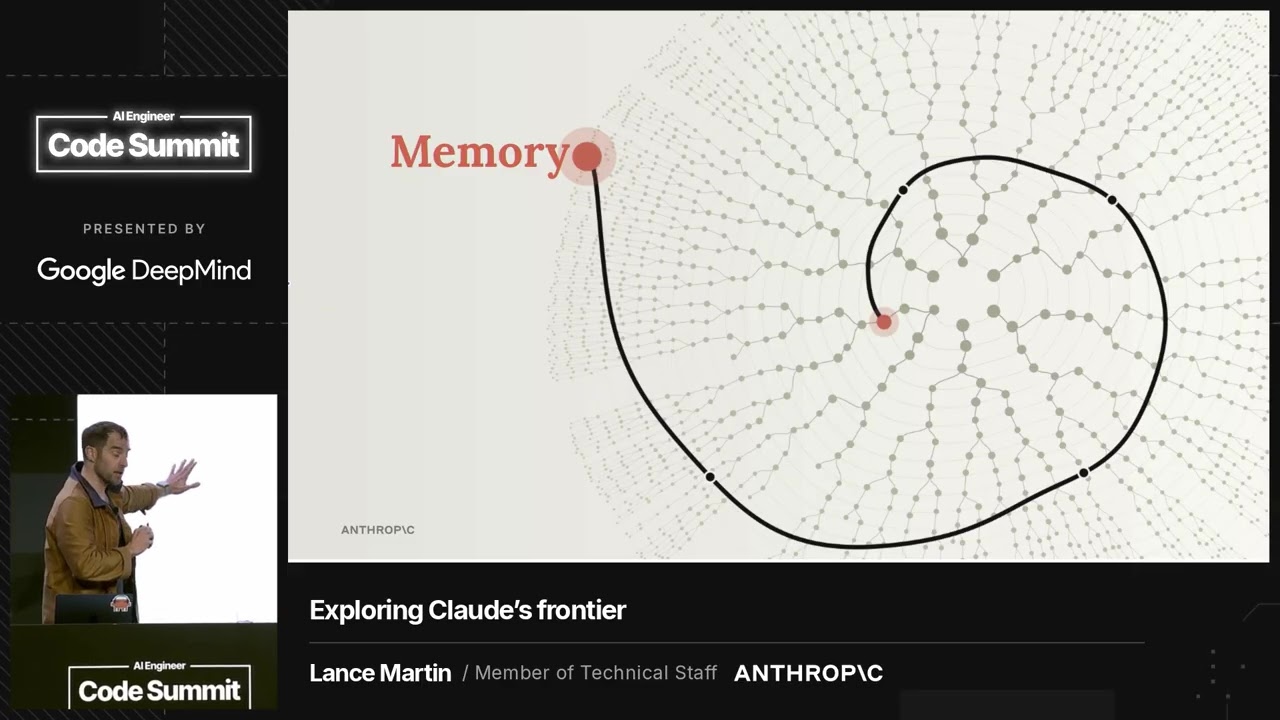
This presentation details two major frontiers in large language model capabilities: autonomous multi-agent systems and advanced memory mechanisms. The first demonstrates a team of 1,000 Claude agents successfully formalizing Fermat's Last Theorem using only basic primitives (Git and SQL database) and no domain-specific harness. The second explores 'memory'—the ability of models to organize context—showing that stronger models (like Fable 5) produce tighter, more strategic memories, and that a process called 'dreaming' can be used to correct 'poisoned memories' and build complex knowledge representations (wikis) from raw data.
Key takeaways
-
Autonomous Agent Orchestration
3:47
A team of 1,000 agents, given only access to Git and a SQL database, successfully coordinated to formalize a complex mathematical proof over 30 hours, demonstrating that agents can solve long-horizon problems without extensive scaffolding.
-
Memory Quality and Salience
17:26
Stronger models (e.g., Fable 5) exhibit better instincts for salience, resulting in 'tighter' and more strategic memories compared to weaker models (e.g., Sonnet 3.7), which produce indiscriminate, unwieldy memories.
-
The Power of Dreaming
The 'dreaming' mechanism allows Claude to reflect over existing transcripts and notes to build new representations (like wikis) or correct errors, such as rescuing the agent from a 'poisoned memory' loop.
Technical details
-
Multi-Agent Architecture
357s
The 1,000-agent system utilized simple primitives: restricted network access to Git and a SQL database. The lead agent autonomously created coordination tables (announcement, subtask, landed status) to manage the state of the project.
-
Memory Benchmarking (CL Bench)
831s
The Continual Learning Benchmark (CL Bench) showed that models improve in their ability to use memory when given a simple instruction to use a memory directory, with stronger models demonstrating better retrieval and writing habits.
-
Knowledge Representation (Wikis)
Claude can natively build knowledge representations, such as wikis, from raw corpora (e.g., company documents/Slack messages). The resulting wiki, when combined with search, improves performance beyond raw semantic search.
Mentioned resources
- Fermat's Last Theorem
- Lean
- Fable 5
- Sonnet 3.7
Channel & topics
Watch on YouTube · Back to latest
This independent, AI-assisted summary is provided for commentary and informational purposes. It may contain errors or omit important context. Please watch the original video for the creator's complete presentation. Video, thumbnail, and related copyrights belong to their respective owners.